By Robert Skinner | Delta City News (DCN) June 27, 2026

If you want the News in Delta Daily, Subscribe Free :

Every day, thousands of shipping containers arrive in Delta carrying everything from electronics and clothing to food products and industrial machinery. Hidden inside one of those containers earlier this year was more than half a tonne of opium.

The obvious question is: How did border officers know which container to inspect?

The answer reveals a fascinating story of intelligence gathering, international cooperation, highly trained professionals and sophisticated technology working quietly behind the scenes to protect Canada's Pacific Gateway.


This Is Not Random

Many people imagine border officers randomly selecting shipping containers for inspection.

The reality is far more sophisticated.

With thousands of containers arriving through Delta's port facilities every day, physically opening every one would bring international trade to a standstill. Instead, the Canada Border Services Agency (CBSA) relies on intelligence-led enforcement—a process that combines data analysis, international information sharing and risk assessment to identify shipments most likely to require closer examination.

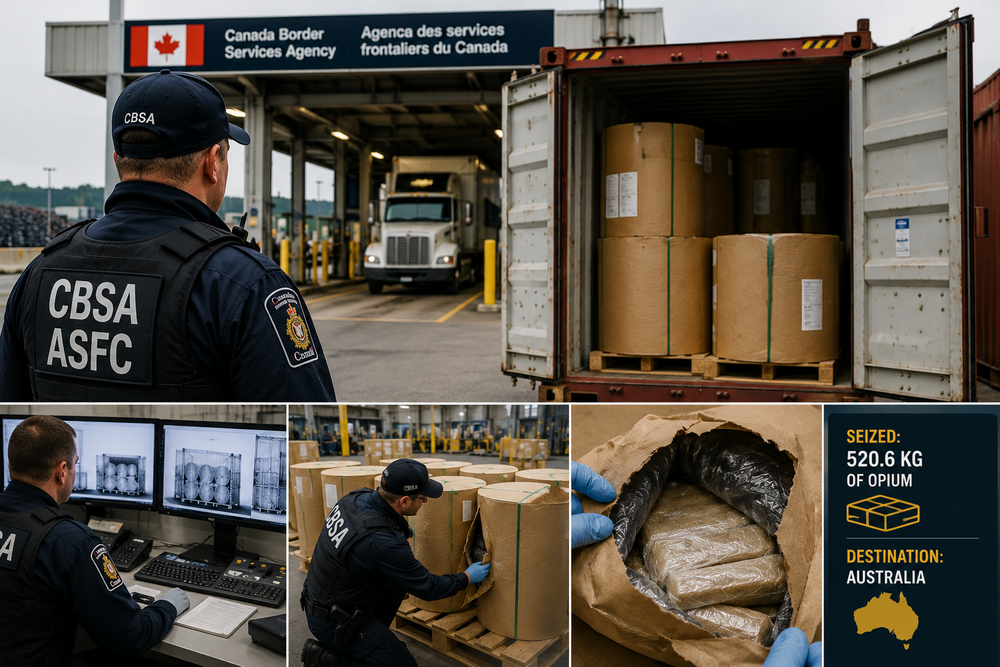
The historic seizure of 520.6 kilograms of concealed opium announced this week began long before the cargo ship arrived in Delta.

According to the CBSA, the shipment was identified through intelligence developed by the agency's National Targeting Centre and Pacific Regional Intelligence Section in cooperation with the United States Customs and Border Protection.

That intelligence led officers to one specific shipping container among thousands moving through Canada's busiest Pacific trade corridor.


A Closer Look Begins

Once the container arrived at Delta's Tsawwassen Container Examination Facility, the next stage of the investigation began.

Rather than immediately opening the shipment, officers followed a carefully planned inspection process.

The first indication came from one of the CBSA's detector dog teams.

Specially trained dogs remain one of the most effective tools available to border agencies. Their ability to detect the scent of narcotics often provides the first confirmation that additional examination is warranted.

In this case, the detector dog alerted officers to the possible presence of contraband hidden somewhere inside the container.

That alert triggered the next stage.


Looking Inside Without Opening Everything

Instead of dismantling the shipment immediately, officers moved the container through specialized X-ray equipment.

The imaging system allows inspectors to see inside cargo without unloading every item, identifying unusual density patterns or structural inconsistencies that would otherwise remain invisible.

Inside the container were large industrial paper rolls.

At first glance, they appeared ordinary.

The X-ray images suggested otherwise.

Several of the rolls showed internal inconsistencies inconsistent with normal paper products.

Those anomalies justified a more detailed physical inspection.


Finding What Was Hidden

Only after intelligence analysis, detector dog screening and X-ray imaging did officers begin opening the shipment.

The inspection revealed opium concealed deep inside ten industrial-sized paper rolls.

In total, officers recovered 520.6 kilograms of opium, making it one of the largest opium seizures ever publicly announced by the CBSA.

Finding narcotics hidden within manufactured products is a reminder that organized crime continually develops increasingly sophisticated concealment methods in an effort to evade detection.

Border officers continually adapt their inspection techniques to meet those evolving challenges.


The People Behind The Process

While headlines naturally focus on the amount of drugs seized, the operation also highlights the work of a wide range of professionals rarely seen by the public.

Behind every successful seizure are intelligence analysts reviewing shipping information, targeting specialists identifying unusual cargo patterns, detector dog handlers, imaging specialists, examination officers and investigators working together as one coordinated team.

Their work often begins days—or even weeks—before a ship reaches Canadian waters.

Most of that work happens quietly, without public attention.

When the system works, Canadians simply see store shelves stocked with products and supply chains moving efficiently.

Few realize the enormous effort required to identify the small number of shipments that present genuine risks.


Why Delta Matters

This operation also illustrates why Delta occupies such an important place in Canada's transportation system.

The community is home to one of the country's busiest international trade gateways, where billions of dollars in legitimate commerce pass through local port facilities every year.

The overwhelming majority of containers arriving in Delta contain lawful commercial goods that support Canadian businesses and consumers.

Border agencies face the challenge of protecting that flow of commerce while identifying the tiny fraction of shipments linked to organized crime.

The success of this operation demonstrates that intelligence-led enforcement allows both objectives to be achieved simultaneously.


Looking Ahead

International trade continues to grow, and so do the challenges facing border security agencies.

Artificial intelligence, advanced analytics, improved imaging systems and stronger international partnerships are becoming increasingly important tools in identifying high-risk shipments without slowing legitimate commerce.

The historic seizure announced this week is more than a story about illegal drugs.

It is an example of how modern border security increasingly depends on information, technology and highly trained professionals working together to protect Canada's economy and its communities.

For Delta residents, it also offers a rare glimpse into an essential public service taking place every day just beyond the port gates.


Why It Matters

The public rarely sees the sophisticated systems operating behind the scenes at Delta's port facilities.

Yet every successful interception protects Canadian communities while preserving confidence in one of the country's most important trade corridors.

Understanding how these operations work helps residents appreciate the critical role Delta plays—not only as an economic engine, but as one of Canada's most important front lines in protecting the nation's borders.


Inside Delta

Protecting Canada's Pacific Gateway – Part 2

This article is part of Delta City News' ongoing series exploring the people, technology and infrastructure that protect one of Canada's busiest international trade gateways.

Coming Next

Part 3 — Delta's Ports Move Billions In Trade Every Year: Why Security And Commerce Must Work Together


Robert Skinner – Publisher

Delta City News — Licensed Partner of the WBN News Network

Robert is a Ladner-based business systems developer and Publisher of Delta City News.

Connect with Robert on LinkedIn:
https://www.linkedin.com/in/rlskinner/

Subscribe Free To Delta City News
https://deltacity.news/subscribe/?fpr=robert10

We're Looking For Citizen Journalists

If you have a passion for your community and would like to help tell Delta's stories, we'd love to hear from you. Part-time contributor opportunities are available, and ChatGPT-assisted journalism training is provided for qualified applicants.

#Delta City News #Delta BC #Border Security #CBSA #Pacific Gateway #Public Safety #Port Of Vancouver #Trade Security #Container Shipping #Crime Prevention #Community News

Share this article
The link has been copied!