
By WBN Global News Desk | WBN News
Subscribe Here: | June 30, 2026

Frontier AI Models Now Ship Under Federal Review

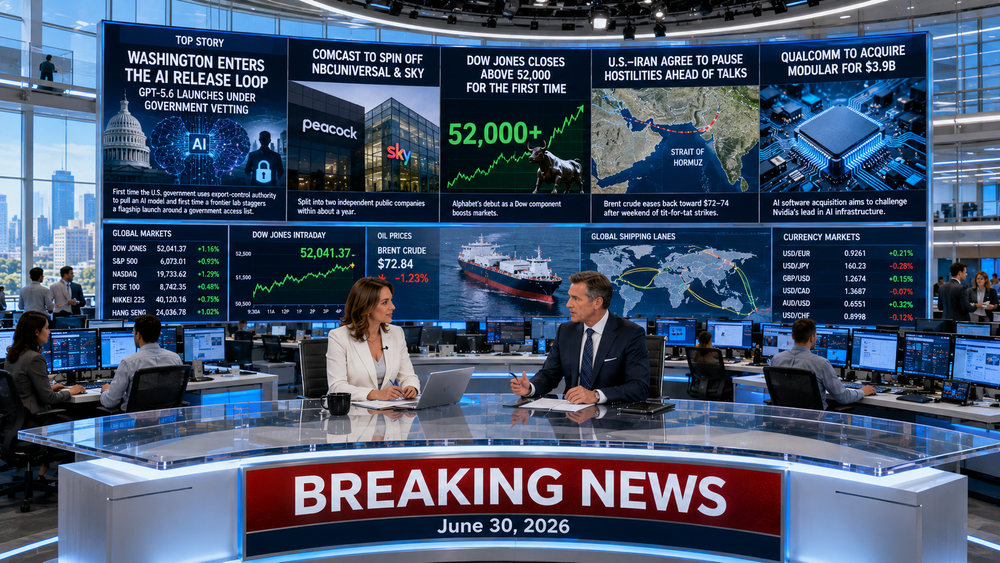
The US government has, for the first time, placed itself directly inside the release loop for commercial AI products. Two weeks after the Commerce Department forced Anthropic to pull its Fable 5 and Mythos 5 models offline worldwide under export-control authority, OpenAI shipped its newest flagship, GPT-5.6, to only about 20 government-vetted organizations rather than the public. Anthropic, for its part, has only partially restored access to Mythos 5 for vetted US organizations as of June 27. Layered on top of this AI policy shift, Comcast confirmed plans to split into two independent public companies, and the Dow Jones Industrial Average closed above 52,000 for the first time, boosted by Alphabet's debut as a Dow component.

The second half of 2026 opens with a structural question that did not exist a month ago: who decides when the most capable AI models reach the public, the company that built them or the government reviewing them first.

πŸ“Œ At A Glance

  • OpenAI launched GPT-5.6 Sol, Terra, and Luna as a government-vetted limited preview to roughly 20 organizations, with broad release expected "in the coming weeks," following the Commerce Department's unprecedented June 12 order forcing Anthropic to suspend Fable 5 and Mythos 5 worldwide
  • Comcast will spin off NBCUniversal and Sky into a separate public company within about a year, sending Comcast shares up more than 20% in a single session
  • The Dow Jones Industrial Average closed above 52,000 for the first time, boosted by Alphabet's first session as a Dow member following its $84.75 billion equity raise
  • The US and Iran agreed to pause hostilities ahead of planned talks in Doha after a weekend of tit-for-tat strikes near the Strait of Hormuz; Brent crude eased back toward $72-74 a barrel
  • Qualcomm agreed to acquire AI software startup Modular for roughly $3.9 billion in stock, aiming to challenge Nvidia's grip on AI infrastructure software

⭐ Top Story

Headline: Washington Enters The AI Release Loop As GPT-5.6 Launches Under Government Vetting

Source: Axios / VentureBeat / OpenAI / The Hacker News / Nextgov-FCW

Summary: OpenAI released its newest flagship model family, GPT-5.6 Sol, Terra, and Luna, on June 26 as a limited preview available only to roughly 20 organizations whose participation was individually approved by the US government, rather than the broad public launch that has accompanied every prior OpenAI release. The company said it previewed the models' capabilities to the federal government ahead of launch and, at the government's request, agreed to stagger access before a general release "in the coming weeks." The arrangement follows an executive order signed on June 2, "Promoting Advanced Artificial Intelligence Innovation and Security," which calls for a voluntary framework that allows the government up to 30 days to review frontier models for cybersecurity risk before public release. OpenAI was explicit that it does not view government-gated access as a long-term default, calling the current approach a short-term accommodation. The precedent for OpenAI's caution is the Commerce Department's June 12 export-control order, which forced Anthropic to suspend its Fable 5 and Mythos 5 models for all users worldwide just three days after launch, following reports of a jailbreak that could allow the models to identify cybersecurity vulnerabilities in critical infrastructure. Anthropic disputed the severity of the jailbreak and has only partially restored Mythos 5 access to vetted US organizations as of June 27, the same day GPT-5.6 entered preview.

Why It Matters: This is the first time the US government has used export-control authority to pull an already-deployed commercial AI model offline, and the first time a frontier lab has voluntarily staggered a flagship launch around a government-approved customer list. Together, the two episodes establish a new pattern for the industry: government preview, government access list, staged public release. For enterprises, investors, and AI developers, the practical effect is that release timelines for the most capable models are no longer set solely by the labs that build them. Both Anthropic and OpenAI are also heading toward what could be the largest IPOs in history, making the question of who controls access to their core product more than a policy abstraction β€” it is now a material business risk that public-market investors will need to price in.


🍁 Canada

Headline: Bank of Canada Projected To Hold Rate At 2.25% Through 2026 as Middle East Shock Clouds Outlook

Source: Parliamentary Budget Officer / Globe and Mail / BNN Bloomberg

Summary: Canada's fiscal watchdog projects the Bank of Canada will hold its policy rate at 2.25% through 2026, an extra year of monetary stimulus compared to earlier forecasts, as inflation driven by Middle East-linked energy costs offsets a still-soft domestic economy. The Parliamentary Budget Officer projects real GDP growth of just 1.1% in 2026, with the federal deficit averaging around $64 billion over five years. Business investment continues to lag as firms hold back amid tariff uncertainty and geopolitical risk.

Why It Matters: Canadian business leaders planning capital expenditure should expect borrowing costs to stay elevated longer than previously assumed, even as energy producers benefit from higher oil prices. The lack of a near-term rate cut adds pressure on sectors already squeezed by US tariffs, particularly manufacturing and non-energy exporters.

Headline: Comcast Spinoff Sends Cross-Border Media Stocks Higher In Canadian Trading

Source: BNN Bloomberg

Summary: Canadian media and telecom-linked equities moved in tandem with the US sector rally following Comcast's spinoff announcement, with cross-listed shares and ETFs tracking North American media stocks posting gains. Analysts note that Canadian cable and broadband operators are closely watching the structural shift as a potential template for their own asset-separation strategies.

Why It Matters: Canadian telecom executives may face renewed investor pressure to simplify corporate structures, particularly where content and connectivity businesses have struggled to deliver combined value.


πŸ¦… United States

Headline: Dow Closes Above 52,000 For First Time As Alphabet Joins The Index

Source: CNBC

Summary: The Dow Jones Industrial Average jumped 306.63 points, or 0.59%, to close above 52,000 for the first time, powered by a nearly 5% gain in Alphabet during its first session as a Dow component. The S&P 500 rose 1.18%, and the Nasdaq Composite gained 2.07% as a pause in US-Iran hostilities lifted sentiment broadly across risk assets. The rally followed a volatile prior week in which AI-related stocks sold off sharply amid concerns about elevated valuations and capital-raising dilution.

Why It Matters: The record close shows investors are willing to look past short-term AI valuation jitters when geopolitical risk eases, even briefly. Business leaders should treat the rally as fragile rather than a definitive turn, given how quickly sentiment reversed during the prior week's tech selloff.

Headline: Qualcomm To Acquire AI Software Startup Modular For $3.9 Billion

Source: Bloomberg / CNBC

Summary: Qualcomm agreed to acquire Modular Inc. in an all-stock deal valued at roughly $3.9 billion, adding software that lets AI models run across different chip architectures without being rewritten for each vendor. The deal, expected to close in the second half of 2026, is aimed at deepening Qualcomm's data-center AI capabilities and challenging Nvidia's CUDA software ecosystem, which still commands an estimated 85% share of the AI accelerator chip market.

Why It Matters: The acquisition signals that chipmakers see software lock-in, not just hardware performance, as the next battleground in AI infrastructure. Enterprises building multi-vendor AI deployments should watch whether Modular can remain credibly vendor-neutral under Qualcomm's ownership.


🌍 Africa

Headline: Kenya's Family Bank Goes Public In Nairobi's Biggest Private-Sector Listing Since 2009

Source: African Business / allAfrica

Summary: Family Bank completed its initial public offering on the Nairobi Securities Exchange, marking the largest private-sector listing on the bourse in over fifteen years. The listing comes as Kenyan markets navigate a separate $2.3 billion Asahi-EABL deal currently snarled in legal disputes, alongside a $1.2 billion airport upgrade agreement with China's CRBC.

Why It Matters: The listing is a rare bright spot for African capital markets, which are starved of large domestic offerings, and may encourage other regional banks to consider public listings as a path to growth capital.

Headline: Standard Bank Wins Renminbi Clearing Status, Anchoring $300 Billion Africa-China Trade Corridor

Source: African Business

Summary: Standard Bank secured renminbi clearing status, positioning Africa's largest bank by assets as a central gateway for an estimated $300 billion in Africa-China trade flows. The designation comes as African ports report a surge in shipping traffic rerouted from the Middle East due to ongoing disruptions in the Strait of Hormuz.

Why It Matters: The clearing status deepens financial ties between Africa and China at a moment when Western development aid to the continent has fallen sharply, giving Beijing an expanded role in African trade infrastructure.


🌎 International

Headline: US And Iran Pause Strikes Ahead Of Doha Talks After Weekend Exchange Near Hormuz

Source: NPR / Al Jazeera / Britannica

Summary: The United States and Iran agreed to halt further attacks ahead of negotiations scheduled to resume in Doha, following a weekend in which Iran's Revolutionary Guard struck US-linked sites in Bahrain and Kuwait in retaliation for American strikes on Iranian coastal radar and drone facilities. The exchange began after Iran targeted a container ship in the Strait of Hormuz, prompting CENTCOM to call the act a clear ceasefire violation. Despite the flare-up, shipping traffic through the strait has continued to recover, with Gulf exports reaching roughly 75% of prewar levels.

Why It Matters: The on-again, off-again nature of the ceasefire keeps a persistent risk premium embedded in oil markets and global shipping insurance costs. Companies with Gulf-dependent supply chains should maintain contingency routing plans rather than assume the de-escalation is durable.

Headline: Japanese Yen Hits Weakest Level Since 1986 As USD/JPY Breaks Above 162

Source: investingLive

Summary: The yen weakened past 162 per dollar for the first time since December 1986, despite warnings of verbal intervention from Japan's Chief Cabinet Secretary and Finance Minister. China's official June manufacturing PMI beat expectations at 50.3, supported by strong tech-linked exports even as domestic demand remained soft.

Why It Matters: A yen at 40-year lows raises the odds of actual currency intervention by Tokyo and increases import costs for Japanese businesses, while offering a competitive boost to Japanese exporters in already-strong tech-export categories.


πŸ‡¦πŸ‡· Latin America

Headline: Latin America's Top Economies Set For Modest 1.9% Growth In 2026 Amid Tariff Strain

Source: Goldman Sachs Research

Summary: The region's seven largest economies are projected to grow 1.9% in 2026, down from roughly 2.1% the prior year, with Mexico's growth weighed down by uncertainty over USMCA renewal and Brazil facing election-year fiscal pressure ahead of October's presidential vote. Peru is expected to lead regional growth on a gold and copper commodity boom, while Argentina's disinflation under President Milei continues to outperform expectations.

Why It Matters: Businesses operating across the region face a bifurcated outlook β€” commodity-linked economies like Peru are positioned to outperform, while Mexico's nearshoring advantage is being offset by trade-policy uncertainty tied to the pending USMCA review.

Headline: Guyana Set To Post Region's Fastest Growth On Offshore Oil Boom

Source: ECLAC

Summary: The Economic Commission for Latin America and the Caribbean projects Guyana's economy will expand by as much as 16.3% in 2026, by far the fastest pace in the region, driven by continued development of its offshore oil reserves.

Why It Matters: Guyana's trajectory illustrates how quickly small economies can be transformed by major resource discoveries, and underscores the country's growing relevance to global oil supply diversification.


πŸ‡ͺπŸ‡Ί Europe

Headline: ECB's Lagarde Signals Return To Conventional Policy Tools At Sintra

Source: CNBC

Summary: European Central Bank President Christine Lagarde used her curtain-raising speech at the ECB's Sintra forum to say the central bank no longer needs to rely on unconventional instruments or complex forward guidance, calling the bank's recent rate increase to address Middle East-driven inflation "justified under every scenario." European equities advanced broadly, with mining and chipmaker stocks, including ASML, leading gains.

Why It Matters: Lagarde's comments suggest the ECB views the current inflation shock as manageable through standard rate tools rather than emergency measures, a reassuring signal for euro-area borrowing costs even as energy-driven inflation persists.

Headline: Comcast Spinoff Echoes Europe's Warner Bros. Discovery Playbook

Source: CNBC

Summary: Industry analysts drew direct comparisons between Comcast's NBCUniversal spinoff and Warner Bros. Discovery's earlier separation, which preceded its roughly $110 billion combination with Paramount Skydance, after the deal cleared DOJ antitrust review on June 12. European broadcasters and streaming platforms are watching the consolidation wave for signals about cross-border content deal-making.

Why It Matters: The split-then-sell pattern emerging in US media is likely to influence how European media groups, several of which carry similarly mismatched legacy and streaming assets, approach their own strategic reviews.


🌏 Asia-Pacific

Headline: China's June Manufacturing PMI Beats Forecasts As Tech Exports Surge

Source: CNBC

Summary: China's official manufacturing purchasing managers' index rose to 50.3 in June, beating forecasts of 50.1 and returning to expansion territory, while the non-manufacturing gauge climbed to 50.2. The improvement was concentrated in high-tech exports tied to the global AI boom, with domestic demand remaining comparatively soft, according to private research firm China Beige Book.

Why It Matters: The export-led rebound suggests China's manufacturing base is successfully capturing demand from the global AI infrastructure buildout, even as policymakers continue to grapple with weak domestic consumption.

Headline: Japan's Nikkei Slips As Middle East Jitters And Yen Weakness Weigh On Sentiment

Source: Trading Economics

Summary: The Nikkei 225 fell as investors monitored renewed clashes between the US and Iran around the Strait of Hormuz, even as Japan's May retail sales rose 5.3%, the fastest pace since November 2023, supported by a government stimulus package. Technology stocks led declines amid concerns about the sustainability of the broader AI rally.

Why It Matters: Japan's domestic consumer strength is being overshadowed by external shocks, illustrating how exposed even resilient economies remain to Middle East-driven volatility and AI-sector sentiment swings.


πŸ€– Artificial Intelligence

Headline: Anthropic Partially Restores Mythos 5 Access As Government Review Continues

Source: Nextgov/FCW / Forbes / Lawfare

Summary: Anthropic restored Mythos 5 access to a set of vetted US organizations on June 27, two weeks after the Commerce Department's Bureau of Industry and Security ordered the company to suspend both Fable 5 and Mythos 5 for all users worldwide. Anthropic has said it continues to work with the government to expand access to Mythos 5 and make Fable 5 available again for general use. The company has consistently disputed the severity of the jailbreak that triggered the order, noting that comparable cybersecurity capabilities are available from other publicly deployed models, including OpenAI's GPT-5.5, without equivalent restrictions.

Why It Matters: The partial, government-paced restoration shows that even after a company complies with an emergency order, regaining full commercial access is neither automatic nor swift. For any AI company operating model deployments at scale, this establishes that a government national-security designation can suspend revenue-generating products indefinitely, with the timeline for restoration controlled externally rather than by the company.

Headline: Alphabet Closes $84.75 Billion Equity Raise, Largest AI Infrastructure Financing On Record

Source: Build Fast with AI

Summary: Alphabet completed its $84.75 billion equity capital raise, the largest equity financing by a major technology company for AI infrastructure in corporate history. The raise includes a $30 billion underwritten public offering, a $40 billion at-the-market program managed by Goldman Sachs, JPMorgan, and Morgan Stanley, and a $10 billion private placement to Berkshire Hathaway, split between Class A and Class C shares. The financing coincided with Alphabet's debut as a Dow Jones Industrial Average component.

Why It Matters: The scale of the raise underscores how capital-intensive the AI infrastructure race has become, with even the largest technology companies turning to public markets rather than relying solely on cash flow to fund compute buildout.


πŸ’Ή Markets

Headline: Brent Crude Eases Toward $72-74 As Hormuz Shipping Activity Recovers

Source: Trading Economics / Reuters

Summary: Brent crude traded between roughly $72 and $74 a barrel, down sharply from wartime highs as shipping transits through the Strait of Hormuz accelerated following the latest US-Iran de-escalation. Saudi Arabia resumed tanker loading at its Ras Tanura terminal, and Gulf exports have recovered to roughly 75% of prewar levels, though hundreds of vessels remain stranded in the Persian Gulf as shipowners stay cautious.

Why It Matters: Falling oil prices ease inflationary pressure globally but remain highly sensitive to any renewed flare-up, meaning businesses with energy-cost exposure should avoid assuming price stability until a durable peace framework is in place.

Headline: Comcast To Split Into Two Public Companies, Spinning Off NBCUniversal And Sky

Source: Bloomberg / CNBC / AP

Summary: Comcast announced plans to separate into two independent publicly traded companies through a tax-free spinoff of NBCUniversal and Sky, splitting its media and entertainment assets from its broadband, mobile, and wireless business. The transaction, expected to close in about a year, will leave Comcast shareholders holding stakes in both companies. Co-CEO Mike Cavanagh will lead the new NBCUniversal, which houses Peacock, Universal's film and theme park business, NBC, and Telemundo, while former CFO Michael Angelakis becomes CEO of the remaining broadband-focused Comcast. Comcast shares surged more than 20% on the news, with Charter Communications also rallying in sympathy. The announcement follows a similar separate-then-sell playbook used by Warner Bros. Discovery ahead of its roughly $110 billion deal with Paramount Skydance.

Why It Matters: The breakup acknowledges that bundling broadband infrastructure with legacy media no longer creates shareholder value in a streaming-dominated landscape. Executives across the media sector should expect the newly independent NBCUniversal to become an acquisition target, with Netflix and Apple cited by analysts as potential buyers despite management's denials of any intent to sell.


πŸ“ˆ IPOs & Capital Raising

Headline: Rocket Lab To Acquire Iridium Communications For Approximately $8 Billion

Source: Schwab Market Update

Summary: Rocket Lab shares surged more than 11% after the launch and space systems company announced plans to acquire satellite communications provider Iridium Communications for approximately $8 billion. Iridium shares climbed 22% on the announcement. Separately, SpaceX shares are set to be added to the Nasdaq-100 index ahead of the market open on July 7.

Why It Matters: The acquisition consolidates satellite communications and launch capabilities under one company, reflecting growing investor appetite for vertically integrated space infrastructure plays as commercial space activity accelerates.

Headline: Government AI Gatekeeping Lands Just As Anthropic And OpenAI Both Eye Historic IPOs

Source: Lawfare / Forbes / Corruption, Crime & Compliance

Summary: Anthropic filed confidential IPO paperwork earlier this month, disclosing a $47 billion revenue run rate and a $965 billion valuation, while OpenAI is reportedly weighing a 2027 listing with a floor valuation around $1 trillion. Both companies are now navigating active government oversight of their flagship products, and at the same time, they are preparing for what could be the largest public listings in AI industry history.

Why It Matters: A government that has shown it can suspend a flagship commercial AI product mid-deployment introduces a new disclosure and valuation risk that public market investors have not previously had to price into AI company prospectuses. How each company addresses this risk in its IPO filings will be closely watched as a bellwether for the sector.


Why It All Matters

Today's stories share a single underlying theme: structural clarity is being rewarded across corporate America, even as new forms of uncertainty, regulatory and geopolitical alike, continue to extract a cost from global markets.

The defining shift is not Comcast's breakup or even the Dow's record close β€” it is that the US government has, for the first time, inserted itself directly into the release timeline of commercial AI products. The Anthropic shutdown on June 12 was the stick; OpenAI's staggered GPT-5.6 rollout to roughly 20 vetted partners is the carrot. Both labs are complying while publicly objecting, and both are heading toward IPOs that will force investors to price a risk that did not exist a month ago: that a flagship AI product can be suspended by a national security order, with restoration on a timeline the company does not control.

Comcast's breakup and Alphabet's record capital raise both reflect companies making decisive, large-scale bets to sharpen their focus, and markets responded with record gains β€” the Dow's first close above 52,000. But that optimism remains tethered to a Middle East ceasefire that has broken down and been patched together multiple times in recent months, with oil prices, shipping routes, and currency markets all still pricing in the risk of renewed escalation near the Strait of Hormuz.

For business leaders, the near-term opportunity lies in capital-intensive sectors such as AI infrastructure and space technology, where well-funded players are consolidating their advantage. The near-term risk is now twofold: energy and supply-chain exposure tied to a single, narrow waterway whose stability no one can yet guarantee, and a new regulatory reality in which the most capable AI models ship only with Washington's sign-off.


WBN Global News Desk
WBN News – Real-Time Intelligence For Business

Subscribe Here: https://wbn.digital/?fpr=george75

Contact: newsdesk@wbnn.news


Editorial Disclaimer

WBN Breaking News is an AI-assisted publication prepared by the WBN Global News Desk using multiple reputable sources and editorial review. Information is believed to be accurate at the time of publication, but may change as events develop; for complete Editorial Standards, AI Governance, and Legal Notices, please visit the WBN Trust Centre.


Tags:
#Breaking News #OpenAI #Anthropic #GPT-5.6 #Artificial Intelligence #Comcast #Dow Jones #Strait of Hormuz #Oil Markets #Global Economy

Share this article
The link has been copied!