By Robert Skinner | Delta City News | August 26, 2026
You can Subscribe for Free To Delta City News: Click Here!
Delta's long-running debate over housing and development has moved beyond council chambers and neighbourhood meetings.
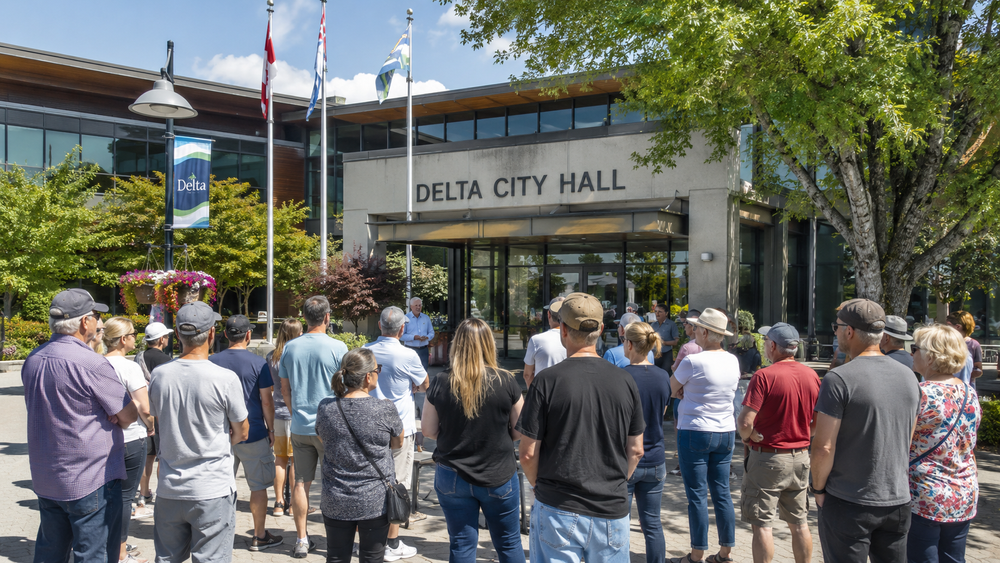
Residents demonstrated outside Delta City Hall on Monday, August 24, calling on council to pause proposed higher-density developments amid growing concerns about infrastructure, traffic, tree loss and changes to established neighbourhoods.
The City Hall demonstration followed an August 16 gathering in Ladner attended by more than 140 people opposed to several development proposals across Delta.
But behind the protests lies a considerably bigger question:
How much control does Delta actually have over the pace of its growth?
Delta Is Under Orders to Build More Housing
The answer begins in Victoria.
In 2023, the Province of British Columbia placed Delta among the first 10 municipalities subject to a Housing Target Order. Delta was directed to achieve 3,607 net new homes over five years.
The City says it must also plan for approximately 14,000 additional homes over the following 20 years to accommodate projected population growth.
Delta has already been moving quickly. Between October 2023 and September 2025, the City reported 1,146 net new housing units and said it had exceeded its annual provincial target for a second consecutive year.
The new Official Community Plan adopted in July 2024 opened additional opportunities for townhouses and apartments and incorporated provincially required small-scale multi-unit housing rules.
Those rules have changed what can be built in neighbourhoods traditionally dominated by single-family homes.
Depending on lot size and location, provincial requirements now allow multiple housing units on many residential properties, including as many as six units on qualifying properties near frequent transit along Scott Road.
Residents Say Growth Is Moving Too Fast
Opponents are not necessarily arguing that Delta should stop growing.
Their central argument is that development should occur at a pace that roads, sewer and water systems, schools, health services, recreation facilities and neighbourhood infrastructure can support.
Those concerns are not new.
During consultation on Delta's 2024 Official Community Plan, residents raised many of the same issues now driving the protests: traffic congestion, infrastructure capacity, public services, environmental protection and preserving neighbourhood character.
The City itself acknowledged those concerns in its consultation report.
One current development that has attracted attention is a proposal at 5090 1st Avenue in Tsawwassen, where a single property would be subdivided into 10 lots accommodating 27 homes in duplex, triplex and fourplex configurations.
The proposal received first, second and third readings from Delta Council on June 29.
It had originally contemplated 35 units before being reduced to 27 following feedback and revisions.
Public concerns recorded by the City included density and neighbourhood character, parking, traffic, removal of mature trees and whether existing infrastructure could accommodate the additional development.
The Other Side of the Debate
There is another reality confronting Delta.
Housing throughout Metro Vancouver remains expensive, and governments are attempting to create more choices for young families, seniors, renters and people who can no longer afford a traditional detached house.
Delta's housing strategy argues that additional townhouses, apartments, secondary suites, coach houses and other forms of housing are necessary if future generations are going to have realistic opportunities to remain in the community.
The City also says areas designated for townhouse and apartment growth either have existing infrastructure capacity or can be supported through future capital upgrades.
That puts Delta Council in a difficult position.
Residents are demanding greater control over the pace and location of development while provincial legislation is deliberately designed to accelerate housing construction and, in some circumstances, reduce the ability of municipalities to prevent it.
A Debate That Is Likely to Grow
There is also a political clock ticking.
Delta voters go to the polls in the municipal election on October 17, 2026.
Housing, development and neighbourhood character were already significant local issues. Residents taking those concerns directly to City Hall suggests they could become defining issues of the campaign.
The argument is therefore no longer simply about whether Delta needs more housing.
Most sides appear to acknowledge that it does.
The increasingly difficult question is how much, how quickly, where it should be built — and whether the infrastructure and services that make Delta desirable can keep pace with the homes being added.
That debate is unlikely to disappear after one protest.
It may only be beginning.
Robert Skinner - Publisher
Delta City News — Licensed Partner of the WBN News Network
Robert is a Ladner-based business systems developer and Publisher of Delta City News. Connect with Robert on: https://www.linkedin.com/in/rlskinner/
You can Subscribe for Free To Delta City News: Click Here!
Also Please Note: We're Looking For Citizen Journalists
If you have a passion for your community in any category, food, sports, lifestyle and would like to help tell your Delta's stories, we'd love to hear from you. Part-time contributor opportunities are available, and ChatGPT-assisted journalism training is provided if desired for qualified applicants.
Apply To Be A News Contributor Here
Tags: #Delta City News #Delta BC #Housing #Development #Ladner #Tsawwassen #North Delta #Community Planning #Housing Density #Local Government