
What Can Busy Metro Vancouver Families Learn From Japanese Homes?
What can busy Metro Vancouver families learn from Japanese homes? From intentional entryways to simple daily resets, these Japanese-inspired habits can make a home easier to maintain.

What can busy Metro Vancouver families learn from Japanese homes? From intentional entryways to simple daily resets, these Japanese-inspired habits can make a home easier to maintain.
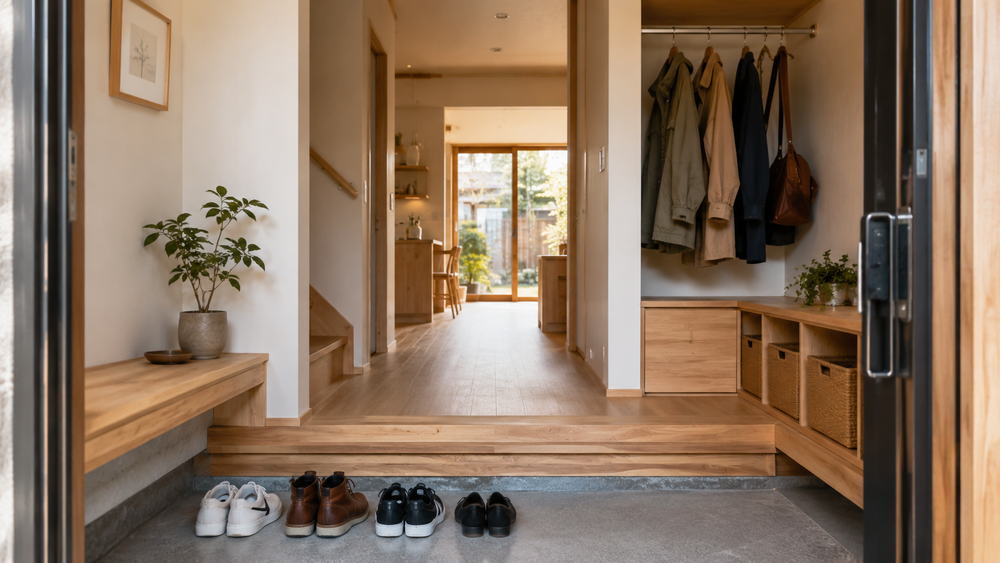
Walk into many Japanese homes and one of the first things you notice is not necessarily how much storage there is.
It is how intentionally the space is used.
Shoes stop at the entrance. Everyday belongings tend to have designated places. Rooms are expected to serve a purpose. Cleaning and caring for shared spaces are habits children are exposed to from an early age.
For families in Metro Vancouver juggling work, school, activities, appointments and increasingly expensive living spaces, there may be something worth paying attention to.
Because keeping a home organized does not necessarily require a bigger home.
Sometimes it requires a different relationship with the space you already have.
One of my favorite Japanese home concepts is the genkan.
The genkan is the entry area found in Japanese homes, usually physically separated from the interior floor. Outdoor shoes are removed there before a person steps into the main living space.
It is more than a shoe-removal tradition. The space creates a very clear boundary between outside and inside.
Japanese architectural and cultural sources describe the genkan as a transition point between the outdoor world and the home, helping keep dirt and outdoor footwear from travelling through living areas.
From an organizing perspective, I love this.
Think about what happens at the entrance of a typical busy family home.
Shoes come off.
Backpacks land somewhere.
Mail gets dropped.
Keys disappear.
Sports equipment arrives.
Reusable bags pile up.
Coats get tossed over a chair.
Within minutes, the outside world has travelled through the house.
A defined drop zone changes that.
You do not need a traditional Japanese entrance to borrow the concept. A basket for each child, hooks that are actually within reach, one designated place for keys, contained shoe storage and a home for incoming paperwork can create the same kind of boundary.
The goal is to stop clutter at the door instead of organizing it later.
This is particularly interesting in Metro Vancouver.
According to the 2021 Census, Vancouver had approximately 305,000 occupied private dwellings, but only about 44,750 were single-detached houses. Apartments, duplexes, townhomes and other attached housing account for the overwhelming majority of homes in the city.
And more than 187,000 Vancouver dwellings had only one to four rooms.
When square footage becomes valuable, every cupboard, drawer and closet has to work harder.
Japan has dealt with that reality for generations, particularly in dense urban areas.
One lesson we can borrow is simple:
Not every possession deserves permanent space in your home.
That does not mean throwing everything away.
In fact, another fascinating Japanese concept points in almost the opposite direction.
The Japanese word mottainai is often translated as “what a waste,” but the concept is broader than simply avoiding garbage.
Japan’s government has described it in relation to reducing, reusing and recycling, with an added sense of respect for the resources and objects we already have.
I think this adds an important nuance to decluttering.
Decluttering should not mean filling garbage bags simply for the sake of having less.
It means making conscious decisions.
Do I use this?
Do I value it?
Could someone else use it?
Am I keeping five when I need two?
Is this item taking up valuable space without contributing anything to my life?
That mindset can actually reduce both clutter and unnecessary buying.
We often try to solve an organizing problem by purchasing another basket, shelf or storage bin.
Sometimes the better solution is to examine what we are asking that basket to hold.
There is also an interesting misconception worth clearing up.
Japan still has an international reputation for extremely long working hours.
But current OECD numbers tell a more complicated story.
In 2025, Japan recorded approximately 1,598 average annual hours worked per worker. Canada recorded approximately 1,687.
So perhaps the question should not be:
“How do Japanese people keep perfect homes while working longer than everyone else?”
There is no country where everyone has a perfectly tidy house.
A more useful question is:
What habits make a home easier to reset when life is busy?
That is where Japanese homes offer some interesting inspiration.
Decide where certain categories stop.
Shoes stay at the entrance.
Paperwork stays in one area.
School bags have one home.
Laundry does not migrate across three rooms.
When items are allowed to spread throughout a house, maintaining order becomes dramatically harder.
The things you use constantly should be the easiest things to put away.
This sounds obvious, but I regularly see homes where rarely used items occupy the best storage while everyday belongings are squeezed into inconvenient places.
If putting something away requires moving three other things first, eventually it will stop getting put away.
Waiting until the entire house is chaotic creates an enormous job.
A five-minute kitchen reset after dinner or a quick entryway reset before bed is far easier than sacrificing half of Saturday to cleaning up accumulated clutter.
Organizing products can be wonderful.
But containers do not reduce the number of possessions you own.
Before buying another bin, ask whether everything going into that bin actually needs to stay.
One of the most valuable organizing lessons we can teach children is that maintaining a home is something everyone participates in.
It does not need to mean hours of chores.
Returning shoes, hanging up a backpack, putting dishes away and resetting a room are small behaviors that become habits.
And habits are ultimately what keep a home organized.
1,598
Average annual hours worked per worker in Japan in 2025, compared with 1,687 in Canada, according to OECD data.
305,335
Occupied private dwellings recorded in Vancouver in the 2021 Census.
44,750
Of those Vancouver dwellings were single-detached houses, meaning the vast majority of residents lived in some form of attached housing.
187,470
Vancouver dwellings had between one and four rooms.
No.
Japan has cluttered homes, overwhelmed households and people who struggle with organization just like anywhere else.
What is interesting are the cultural and architectural practices that can make maintaining order easier. We can learn from those practices without idealizing an entire country.
Absolutely not.
Minimalism and organization are not the same thing.
You can own plenty of things and still have an organized home if those belongings fit comfortably within the space available and have logical homes.
The problem begins when the volume of possessions exceeds the space or energy available to manage them.
Start at the entrance.
Create a clear landing zone for shoes, keys, bags, coats and incoming items.
The less clutter that travels into the rest of your home, the less you have to retrieve and organize later.
Make putting something away easier than leaving it out.
Children are especially unlikely to maintain complicated organizing systems.
Use open baskets where appropriate. Lower hooks. Clear categories. Simple labels. Fewer steps.
A system that looks beautiful but requires six steps to maintain will usually fail in a busy household.
No.
Good organization is not about creating a home that looks untouched.
Frequently used belongings should be easy to access, and sometimes visible storage is the most functional choice.
The goal is not perfection.
It is creating a home that can return to order without requiring enormous amounts of time and energy.
When we look at beautifully organized homes, it is tempting to assume the people living there are simply better at keeping things tidy.
Usually, that misses the point.
The most successful homes have systems that quietly influence what happens next.
There is somewhere to put your shoes.
There is somewhere to drop your keys.
There is a logical place for the things you use every day.
There is enough space to put belongings away without fighting with an overflowing cupboard.
And when something enters the home, there is at least some thought given to whether it deserves to remain there.
That is what Metro Vancouver families can borrow from Japanese homes.
Not perfection.
Intention.
And when life is already busy, a home that requires fewer decisions, fewer searches and fewer major cleanups can give you something much more valuable than a perfectly organized cupboard.
It can give you back a little time.
Florena Davies is the owner of OBF | Organize by Flo, serving Surrey, Delta, Langley, White Rock, and the Lower Mainland. She specializes in creating customized organizing systems that are functional, sustainable, and tailored to the way each client lives.
For Consultations:
P. 778-872-8468
📧 florena@organizebyflo.ca
🌐 www.organizebyflo.com
Please Subscribe Free To Delta City News: Click Here!
TAGS: #Home Organization #Organizing Tips #Decluttering #Organize By Flo #Family Life #Lower Mainland #Stress Free Living #Professional Organizer #Productivity Tips #Home Organizer #Professional Home Organization #Delta City News #Florena Davies #Back to School