By Robert Skinner | Delta City News | November 2, 2026

Please Subscribe for Free To Delta City News: Click Here!

Nearly $400 million spent before construction ramped up

The incoming BC Conservative government's commitment to replace the George Massey Tunnel with a 10-lane bridge has generated considerable discussion about potential savings, faster construction and long-term transportation reliability.

But there is another financial question that deserves immediate attention.

What happens to the hundreds of millions of dollars already invested in the eight-lane tunnel project?

According to the British Columbia Ministry of Transportation and Transit's 2026/27 Service Plan, the Fraser River Tunnel Project had accumulated $398 million in expenditures by December 31, 2025.

The project's official monthly status report provides a more precise figure: $397.8 million.

That expenditure predates much of the physical construction activity that began on Deas Island and along Highway 99 in January 2026.

The total amount spent by November 2026 is therefore likely higher, although an updated, independently verified cumulative expenditure figure has not yet been established for this report.

With the incoming government now planning to abandon the tunnel in favour of a bridge, Delta residents and British Columbia taxpayers have good reason to ask what portion of that investment will remain useful.

The answer is not as simple as calculating how much money has already been spent.

Some expenditures may have lasting value. Others may have little or no application to a bridge.

Understanding the difference is essential to determining the real cost of changing direction.

How did the tunnel project reach $8.5 billion?

The tunnel project approved under the previous NDP government was initially estimated at approximately $4.15 billion.

That estimate covered an eight-lane immersed-tube tunnel, replacement of the Deas Slough Bridge, highway approaches, transit facilities and active transportation infrastructure.

By July 2026, the provincial government announced that the estimated project cost had increased to $8.5 billion.

The revised budget reflected market conditions, inflation, updated project requirements and construction scheduling.

The province also confirmed that major tunnel construction was expected to begin in 2027, with completion targeted for September 2031.

British Columbia News Archive

The substantial increase in projected cost became a central issue in the provincial election campaign.

Conservative representatives argued that reviving the previously cancelled 10-lane bridge would provide a more affordable and faster alternative.

Delta South MLA Ian Paton has suggested that a bridge could save approximately $5 billion and be completed within five years.

However, those projected savings must be evaluated against the full cost of transitioning from the tunnel project.

That includes work already completed, existing contractual commitments and any new engineering or regulatory requirements.

What has actually been built?

The tunnel project has progressed beyond planning and engineering.

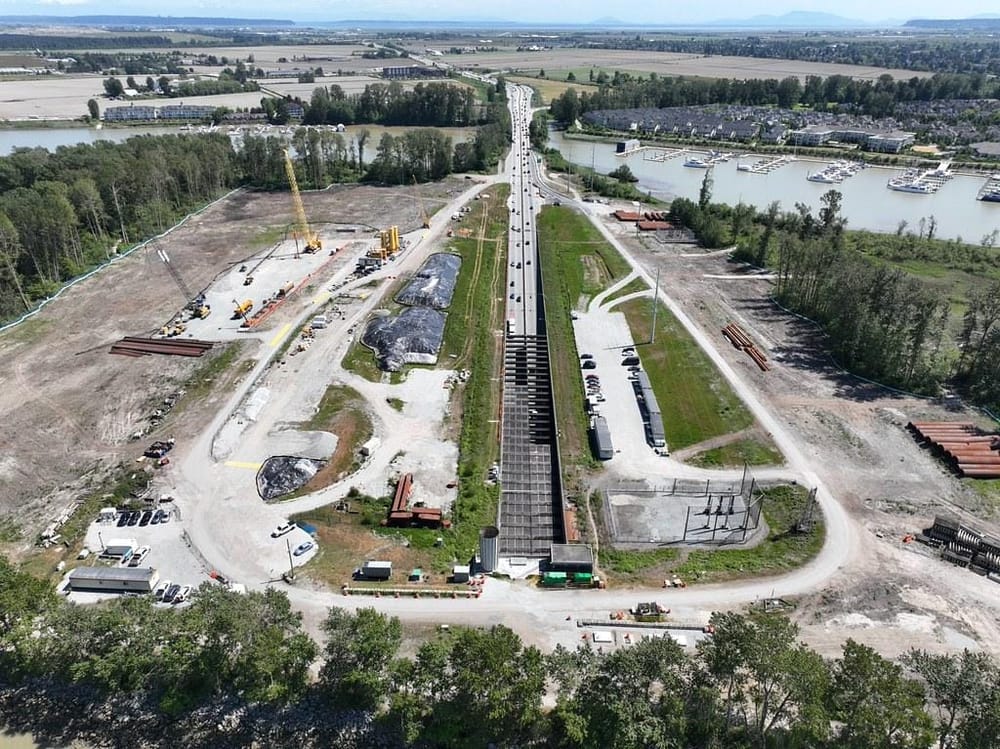
According to the province's Highway 99 Tunnel Program, preparatory construction began in January 2026 and has included work on Deas Island and both sides of the Fraser River.

The publicly documented activities include site clearing, utility relocations, access roads, geotechnical investigations, earthworks and preparations for temporary construction facilities.

More specialized work has included installing steel retaining walls for the Deas Island casting basin, which was intended to support construction of the tunnel's large concrete sections.

Work has also been underway on temporary infrastructure associated with access to Deas Island and the replacement of the Deas Slough Bridge.

An October 20 project update identified construction of a temporary trestle bridge east of the existing Deas Slough Bridge, with work expected to continue into February 2027.

These activities represent real construction expenditures.

But the extent to which each component could be used for a bridge remains uncertain.

The casting basin: A potentially significant write-off

One of the most obvious areas of concern is the Deas Island casting basin.

An immersed-tube tunnel is constructed using large concrete sections manufactured in a specialized facility. Those sections are subsequently transported into position and installed beneath the riverbed.

The casting basin is therefore a fundamental component of the tunnel construction process.

A bridge would be built using a different engineering approach, involving foundations, piers, supporting structures and elevated spans.

The casting basin itself would not normally be required for bridge construction.

This raises several questions.

How much has already been spent preparing the casting basin? What is the value of the installed retaining walls, excavation and supporting infrastructure? Would any of the completed work be useful for a bridge?

And if the facility is abandoned, would the province face additional costs to restore the site?

The province's published construction updates establish that work has taken place, but do not provide a sufficiently detailed cost breakdown to calculate the potential loss.

It would be premature to assign a dollar figure without that information.

Nevertheless, the casting basin represents one of the clearest examples of tunnel-specific investment that warrants financial examination.

Not all the work would necessarily be wasted

It would be misleading to suggest that every dollar spent on the tunnel project would be lost if the province switches to a bridge.

Some expenditures could provide continuing value.

Geotechnical investigations, for example, have generated information about soil conditions and geological characteristics along the Highway 99 corridor.

That information may be useful to bridge engineers, although additional investigations would almost certainly be required to address different foundation and structural requirements.

Utility relocations could also retain value if the bridge follows a similar alignment.

Likewise, certain access roads, site improvements, property acquisitions and environmental studies might remain relevant.

Work associated with replacing the Deas Slough Bridge could be particularly important because both crossing concepts involve improvements to that portion of the Highway 99 corridor.

However, none of these components should automatically be considered reusable without engineering confirmation.

What could be saved?

Existing investment

Preliminary assessment

Tunnel casting basin

Likely limited reuse

Immersed-tube design and engineering

Largely tunnel-specific

Geotechnical investigations

Potentially reusable

Utility relocations

Depends on bridge alignment

Deas Slough Bridge preparations

Potentially reusable

Temporary access roads and trestle

Depends on construction plan

Environmental studies

Some findings may remain useful

Land acquisition

Depends on final bridge design

These are preliminary assessments, not confirmed government determinations.

A detailed engineering and financial review would be required to establish the value of each category.

The cost of cancelled contracts

There is another consideration that may not be immediately visible to motorists passing the construction site.

Major infrastructure projects involve extensive contractual obligations.

These may include engineering services, procurement agreements, equipment commitments, construction subcontracts and specialized materials.

In June 2026, the previous government announced that it was changing its procurement approach after negotiations with the Cross Fraser Partnership failed to produce an agreement for the final construction phase.

The province subsequently moved toward separate construction packages while continuing early works.

That change had already raised questions about project management and financial accountability.

On June 15, Delta Councillor Dylan Kruger introduced a motion calling for an independent review of the tunnel project's procurement difficulties.

The motion specifically sought disclosure of costs incurred on planning, design, procurement and early works, as well as the financial consequences of terminating the procurement process.

It also called for examination of the revised budget and completion schedule.

Those concerns are now even more relevant.

A complete financial assessment of the proposed bridge should include any costs arising from terminating, modifying or settling existing tunnel-related contracts.

Without those figures, it is impossible to determine the complete cost of abandoning the tunnel.

We've been through this before

The George Massey crossing has already experienced one costly change in direction.

When the NDP government cancelled the original 10-lane bridge project in 2017, substantial planning, design and preparatory work had already been undertaken.

Contemporary reporting has placed the sunk costs associated with that cancellation at approximately $100 million.

The province subsequently spent years developing the replacement tunnel proposal.

Now, with a new government preparing to revive the bridge concept, British Columbia faces the possibility of writing off additional expenditures.

The two situations are not identical.

Some work undertaken for the original bridge may still have value today, while some tunnel-related expenditures could potentially support the new project.

But the history illustrates why major infrastructure decisions require long-term planning that can survive changes in government.

A project of this scale should not be evaluated solely on the basis of the construction budget announced by whichever political party happens to be in office.

The cumulative cost of planning, redesigning, cancelling and restarting projects matters too.

What about the workers already on site?

The proposed change also raises immediate employment concerns.

The BC Building Trades organization warned in October that approximately 200 tradespeople working on the tunnel project could face job losses if the project is cancelled.

The organization also raised concerns about additional construction jobs that would have been created during later phases.

For workers and their families, the timing of the transition matters.

If construction stops before a bridge project is ready to proceed, there could be a period of uncertainty or unemployment.

On the other hand, a new bridge would eventually create substantial construction employment of its own.

The question is how the government intends to manage the transition and whether existing workers, contractors and construction infrastructure can be incorporated into the new project.

Will the bridge still save billions?

Supporters of the bridge maintain that the new crossing could be built at substantially lower cost than the $8.5-billion tunnel.

That may ultimately prove correct.

However, a fair comparison requires more than subtracting one proposed construction budget from another.

The full financial picture must include the updated cost of the bridge, the cost of terminating or modifying tunnel contracts, site-restoration requirements, additional engineering and approvals, and the value of infrastructure that can be reused.

There is also an important accounting distinction.

Money already spent is a sunk cost. It cannot be recovered merely by continuing with the tunnel.

The decision about what to build next should primarily consider the remaining costs, future benefits and risks of each option.

But taxpayers are still entitled to know how much public money has been spent on the project and how much of that investment will provide no lasting value.

The two questions are related, but they are not the same.

The construction timeline is also a financial issue

Delays carry economic consequences.

For Delta businesses, commercial truck operators and daily commuters, congestion at the existing George Massey Tunnel represents a continuing cost.

Longer travel times affect productivity, fuel consumption, delivery schedules and access to employment.

If a bridge can genuinely be completed sooner, those benefits deserve consideration in the financial analysis.

But if switching projects results in additional years of planning, environmental reviews or procurement delays, the economic costs of congestion will continue.

A realistic comparison must therefore consider both construction expenditure and the economic value of delivering a reliable crossing sooner.

Cost, timeline and long-term reliability remain the three essential measures of success.

Five answers the province should provide

Before committing to the final bridge design, the incoming government should release a comprehensive financial accounting.

The public deserves answers to five questions:

  1. What is the total amount spent on the Fraser River Tunnel Project as of October 31, 2026?
  2. How much of that spending relates to work that cannot be incorporated into a bridge project?
  3. What is the estimated cost of cancelling or modifying existing construction and engineering contracts?
  4. Which completed infrastructure components, studies and land acquisitions can be reused?
  5. What is the updated total cost and realistic completion date for the proposed bridge, including all transition expenses?

These answers would allow residents to judge the financial merits of the decision using evidence rather than political claims.

The bottom line for Delta

The return to a 10-lane Massey Bridge could prove to be a significant improvement for Delta residents, businesses and the broader Lower Mainland.

A less expensive crossing that can be completed sooner and operate reliably for decades would be a welcome outcome.

But that result has not yet been demonstrated.

What we do know is that nearly $400 million had already been spent on the tunnel project by the end of 2025, before much of the physical construction work began in 2026.

The full investment is now higher, although the current total and potential write-off remain to be established.

That is why the new government should make a detailed financial accounting one of its first priorities.

The question is not whether the province should continue spending billions on a tunnel simply because money has already been invested.

The question is whether changing to a bridge represents better value for taxpayers after all the costs, risks and long-term benefits are considered.

Delta residents have waited long enough for a replacement crossing.

They deserve a project that is affordable, timely and reliable — and a clear explanation of what has happened to the money already spent.

Robert Skinner - Publisher

Delta City News — Licensed Partner of the WBN News Network providing independent community and business reporting covering the people, infrastructure and issues shaping Delta.

Robert is a Ladner-based business systems developer and Publisher of Delta City News. Connect with Robert on: https://www.linkedin.com/in/rlskinner/

You can Subscribe for Free To Delta City News: Click Here!

Also Please Note: We're Looking For Citizen Journalists

If you have a passion for your community in any category, food, sports, lifestyle and would like to help tell your Delta's stories, we'd love to hear from you. Part-time contributor opportunities are available, and ChatGPT-assisted journalism training is provided if desired for qualified applicants.

Apply To Be A News Contributor Here

Tags: Delta Infrastructure, George Massey Tunnel, George Massey Bridge, Highway 99, Transportation, Provincial Government, Public Spending, Special Report

Share this article
The link has been copied!