By Karalee Greer |Vancouver City News| July 13-19, 2026
Subscription to WBN and being a Contributor is Free
Editor's Note: The "On This Week" series highlights the most historically significant verified events that occurred during each featured week. Some weeks naturally feature landmark events concentrated in certain regions of the world. Rather than force geographic balance, this edition focuses on the strongest documented historical milestones for this period.
History is often shaped by moments that redefine nations, inspire social change, advance scientific discovery, and transform global cooperation. The week of July 13 to July 19 includes milestones in democracy, human rights, exploration, science, and humanitarian action that continue to influence the modern world.
History Around The World
The Americas
On July 13, 1787, the Congress of the Confederation adopted the Northwest Ordinance, establishing the framework for governing and admitting new states into the United States. The legislation prohibited slavery in the Northwest Territory and became one of the nation's most influential early laws.
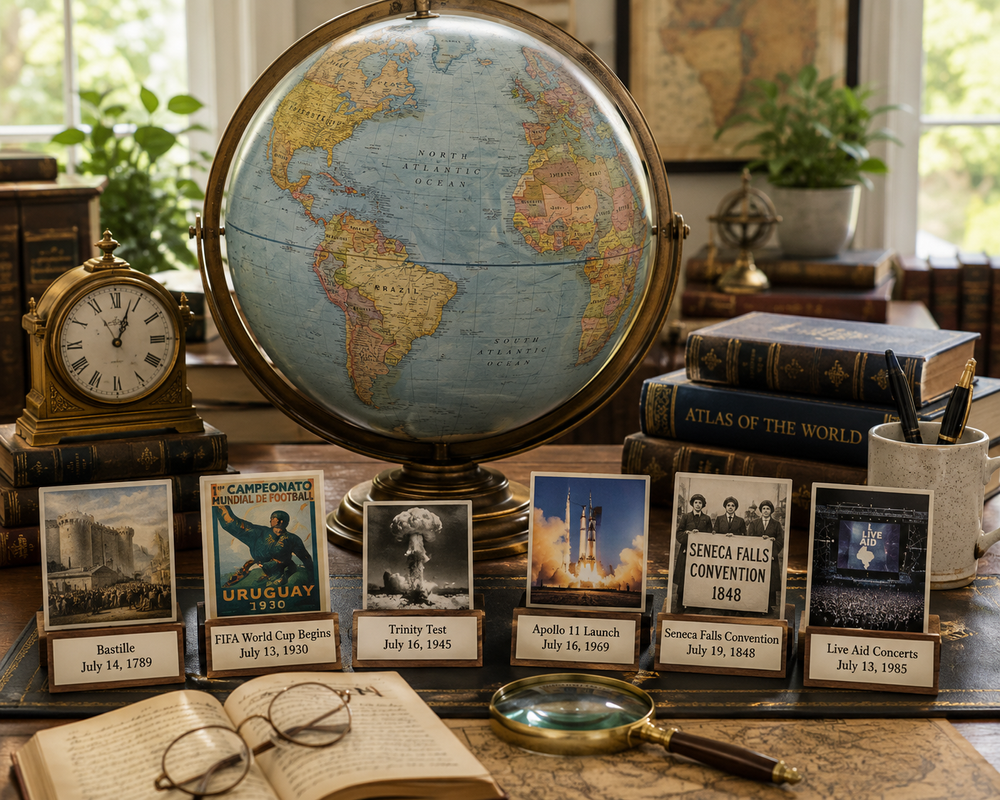
On July 13, 1930, the first FIFA World Cup began in Montevideo, Uruguay. Organized by FIFA, the tournament marked the beginning of the world's largest international football competition and forever changed global sport.
On July 16, 1945, the United States conducted the Trinity Test in New Mexico, successfully detonating the world's first nuclear weapon. The event ushered in the Atomic Age and fundamentally changed international politics, military strategy, and scientific research.
On July 19, 1848, the Seneca Falls Convention opened in New York, becoming the first organized women's rights convention in the United States. Its Declaration of Sentiments helped launch the modern women's rights movement.
Europe
On July 14, 1789, citizens of Paris stormed the Bastille prison, an event widely regarded as the beginning of the French Revolution. The uprising became a lasting symbol of liberty, equality, and popular sovereignty.
On July 17, 1918, Tsar Nicholas II and his family were executed in Yekaterinburg, bringing a definitive end to more than three centuries of Romanov rule in Russia and marking a pivotal moment in the Russian Revolution.
Global Turning Points
On July 13, 1985, the Live Aid concerts were held simultaneously in London and Philadelphia, raising unprecedented funds for famine relief in Ethiopia while demonstrating the power of global humanitarian cooperation through music.
On July 16, 1969, Apollo 11 lifted off from Kennedy Space Center on humanity's first mission to land astronauts on the Moon. Four days later, Neil Armstrong and Buzz Aldrin would make history with the first lunar landing.
Science & Technology Watch
The week of July 13 to July 19 reflects humanity's remarkable capacity for innovation and discovery. Apollo 11 demonstrated what international scientific collaboration and engineering excellence could achieve, while the Trinity Test forever changed our understanding of both the promise and responsibility that accompany scientific advancement.
Weather & Nature Watch
Mid-July brings the height of summer across much of the Northern Hemisphere, with long daylight hours supporting agriculture, festivals, travel, and recreation. Many regions also experience peak wildfire season, drought monitoring, and elevated temperatures, while the Southern Hemisphere continues through the heart of winter.
Series Note: “On This Week” explores significant global events, discoveries, turning points, and cultural milestones connected to each calendar week throughout the year.”
By: Karalee Greer LinkedIn: https://www.linkedin.com/in/karalee/ Subscription to WBN and being a Contributor is Free
Tags: #Delta City News #On This Week #World History #Karalee Greer #Interesting Facts #Global Events