
On This Week | August 24–30, 2026: Moments That Shaped Our World
From civil rights and independence to Voyager at Neptune and the nuclear age, August 24–30 reveals moments that reshaped our world

From civil rights and independence to Voyager at Neptune and the nuclear age, August 24–30 reveals moments that reshaped our world
By Karalee Greer |Delta City News| August 24-30, 2026
Subscription to WBN and being a Contributor is Free
Editor’s Note: “On This Week” features the strongest verified historical events connected to each calendar week. Historical significance takes priority over including every region equally.
Some weeks in history are defined by a single event. August 24 to 30 is remarkable for something different: across centuries and continents, these seven days repeatedly became moments when people reconsidered freedom, equality, peace and humanity’s place in the world.
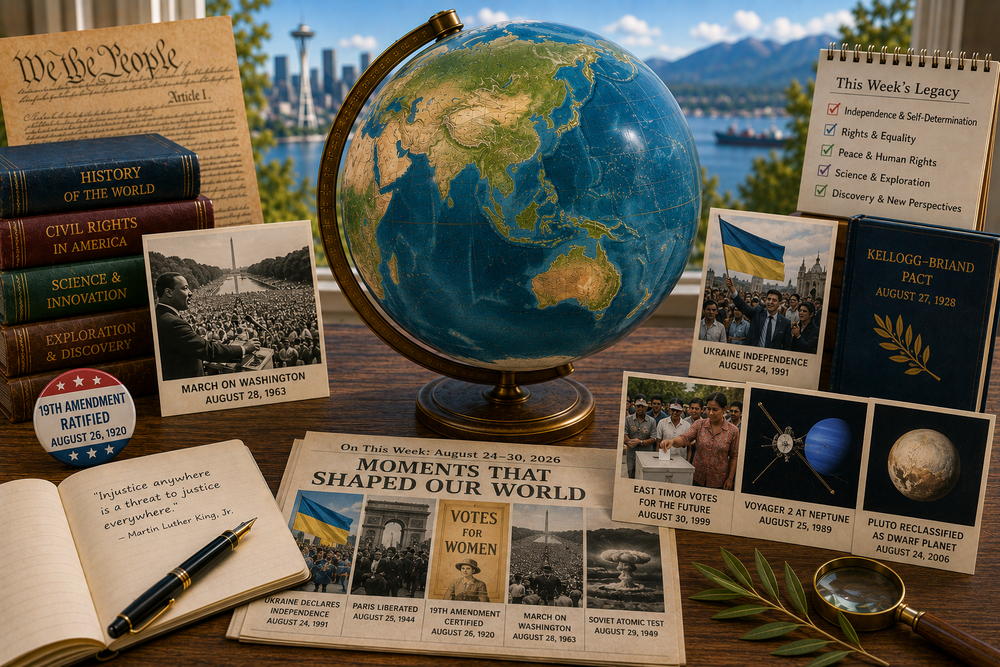
Ukraine declared independence as the Soviet Union was coming apart. Women in the United States reached the final legal milestone in a decades-long struggle for voting rights. Hundreds of thousands marched on Washington for civil and economic equality. East Timorese voters took an extraordinary step toward self-determination.
At the same time, diplomats attempted to outlaw war, the nuclear balance of the Cold War changed dramatically, and a spacecraft travelling billions of kilometres from Earth gave humanity its first close look at Neptune.
On August 26, 1920, U.S. Secretary of State Bainbridge Colby formally certified the ratification of the 19th Amendment to the United States Constitution, declaring that voting rights could not be denied on account of sex.
Tennessee had provided the crucial 36th state ratification eight days earlier. Certification completed a political struggle stretching back generations and dramatically expanded the American electorate.
The achievement, however, did not guarantee equal access to the ballot for all women. Discriminatory state laws and practices continued to prevent many Black women and other minority women from exercising their voting rights for decades.
August 26 is now commemorated in the United States as Women’s Equality Day.
On August 28, 1963, more than 250,000 people gathered in Washington, D.C., for the March on Washington for Jobs and Freedom, one of the defining demonstrations of the American civil rights movement.
Organized by a coalition of civil rights, religious and labour leaders, the march called for civil rights legislation, integrated education, voting rights and greater economic opportunity.
From the steps of the Lincoln Memorial, Dr. Martin Luther King Jr. delivered his famous “I Have a Dream” speech.
But King was only one part of a much larger movement represented that day. A. Philip Randolph, Bayard Rustin, John Lewis, Roy Wilkins, Whitney Young and many others helped organize or address the gathering. The march increased national pressure for civil rights reforms that would follow during the 1960s.
On August 24, 1991, Ukraine’s parliament adopted the Act of Declaration of Independence, declaring Ukraine an independent democratic state.
The decision came just days after the failed coup attempt by hard-line Soviet officials in Moscow and during the accelerating collapse of the Soviet Union.
The declaration was put before Ukrainian voters in a referendum on December 1, 1991, when an overwhelming majority supported independence.
August 24 remains Ukraine’s Independence Day, and the anniversary has taken on profound significance amid the country's continuing defence of its sovereignty and territorial integrity.
On August 25, 1944, after more than four years of Nazi occupation, German forces in Paris surrendered as French and Allied troops entered the city.
The liberation followed an uprising by the French Resistance and the arrival of the French 2nd Armoured Division and U.S. forces. German commander Dietrich von Choltitz surrendered rather than carry out orders associated with the destruction of Paris.
The following day, General Charles de Gaulle led a triumphant procession through the city.
The liberation of Paris became one of the most powerful symbols of occupied Europe emerging from Nazi rule.
On August 27, 1928, fifteen nations signed the Kellogg-Briand Pact in Paris.
Its central idea was extraordinary: participating countries agreed to renounce war as an instrument of national policy and pledged to resolve international disputes peacefully. Eventually, most established nations joined the agreement.
The pact had a profound weakness—it lacked an effective enforcement mechanism. Within little more than a decade, many of its signatories were fighting in the Second World War.
Yet its principles were not meaningless. The idea that aggressive war could be considered illegitimate helped influence later developments in international law and the postwar international system.
On August 27, 1991, Moldova's parliament adopted its Declaration of Independence, separating the republic from the rapidly disintegrating Soviet Union.
The anniversary is particularly notable in 2026: Moldova marked 35 years of independence this August 27.
Like Ukraine's declaration three days earlier, Moldova's independence was part of the dramatic political transformation that reshaped Europe at the end of the Cold War.
On August 30, 1999, the people of East Timor participated in a United Nations-organized referendum that became a decisive step toward independence.
Despite intimidation and an extremely tense security environment, roughly 98 percent of registered voters participated. More than 78 percent rejected the proposal for special autonomy within Indonesia, choosing instead a process leading toward independence.
Violence followed the ballot, and an international intervention was eventually required to restore security.
After a United Nations-administered transition, East Timor—now Timor-Leste—became an independent country on May 20, 2002.
The 1999 vote remains a powerful example of people using the ballot to determine their country's political future.
On August 29, 1949, the Soviet Union detonated its first atomic device.
Until then, the United States had been the world's only nuclear-armed nation. The Soviet test abruptly ended that monopoly and fundamentally changed the strategic balance of the Cold War.
The development intensified the nuclear arms race and contributed to the push toward even more powerful thermonuclear weapons.
It also introduced a frightening new reality: two geopolitical adversaries now possessed weapons capable of destruction on an unprecedented scale.
The consequences would shape international diplomacy, military strategy and public anxiety for decades.
On August 25, 1989, NASA's Voyager 2 spacecraft made its historic closest approach to Neptune.
After travelling roughly 7 billion kilometres, Voyager 2 passed about 4,800 kilometres above Neptune's cloud tops. It became—and remains—the only spacecraft ever to visit the solar system's eighth planet.
What it found surprised scientists.
Voyager discovered six new moons and four rings and revealed an unexpectedly dynamic planet with powerful winds and enormous atmospheric storms. Its observations of Neptune's moon Triton also revealed evidence of active geyser-like plumes despite temperatures approaching –235°C.
Another astronomical anniversary arrived just one day earlier.
On August 24, 2006, the International Astronomical Union adopted a new definition of a planet and classified Pluto as a dwarf planet, leaving the solar system with eight recognized planets.
Twenty years later, scientists still debate aspects of that definition—but the controversy has also helped draw attention to the remarkable diversity of worlds beyond Neptune.
The strengthening El Niño continues to be one of the world's most important environmental stories as August draws to a close.
Its influence is becoming particularly visible in India, where the 2026 monsoon is shaping up to be the weakest in nearly two decades. Rainfall since June 1 was running approximately 13 percent below average as of August 24, with strengthening El Niño conditions expected to suppress rainfall further.
The consequences extend far beyond the weather forecast. India's monsoon supplies water for farms, reservoirs and hundreds of millions of people. Reduced rainfall can affect crops including rice, corn, soybeans and pulses, potentially influencing food prices and rural incomes.
Meanwhile, the eastern Pacific hurricane season is highly active as August ends. Hurricane Karina rapidly intensified into a Category 4 hurricane well offshore on August 31, while Tropical Storm Lowell was also strengthening farther west. Neither posed an immediate landfall threat at the time, although dangerous ocean swells were possible.
Wildfire conditions are also severe in parts of western North America. The Hawk Fire near Reno, Nevada, destroyed more than 30 homes and forced tens of thousands of residents to evacuate during the final week of August.
From weakened monsoons to powerful Pacific storms and severe wildfire conditions, this week's environmental stories demonstrate how changes in ocean and atmospheric patterns can produce very different consequences around the world.
Series Note: “On This Week” explores significant global events, discoveries, turning points, and cultural milestones connected to each calendar week throughout the year
By Karalee Greer |Delta City News
LinkedIn: https://www.linkedin.com/in/karalee/
Subscription to Delta City News and being a Contributor is Free
Tags: #Delta City News #On This Week #World History #Karalee Greer #Interesting Facts #Global Events