With hundreds of millions already spent, competing savings estimates and a new government days away from taking office, Delta residents are entitled to ask when political promises will become a credible construction plan.

By Robert Skinner | Delta City News | November 16, 2026

If you plan to Attend the Event: Click Here!

Another week, another change in direction

Just when Delta residents might have thought the future of the George Massey crossing was becoming clearer, another development has raised fresh questions.

On November 12, Premier-designate Lorne Doerkson called on the outgoing NDP government to stop construction work that would commit British Columbia further to the proposed eight-lane tunnel.

But he wasn't calling for a complete shutdown.

Work that could support either a bridge or tunnel should continue, he said, while his incoming government reviews the alternatives.

Doerkson remains committed to replacing the aging tunnel with a 10-lane bridge. However, the formal review and supporting financial documents have yet to be released.

For residents who have watched this project change direction repeatedly, the obvious question is:

How can we be preparing to cancel one project when we still haven't seen the complete plan for its replacement?

How much money are we spending while politicians decide?

The financial numbers are becoming increasingly difficult to ignore.

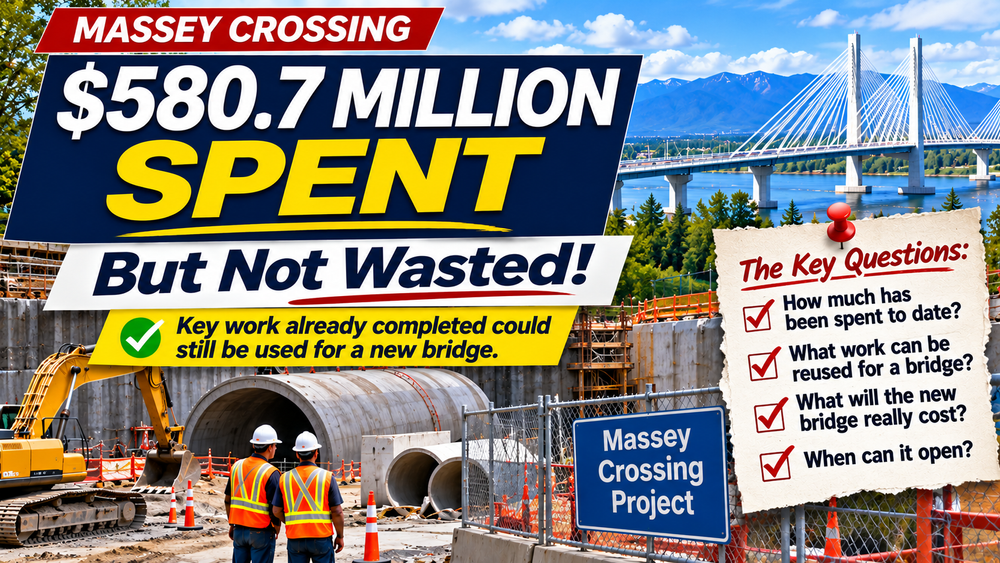
Provincial records showed approximately $398 million had been spent on the Fraser River Tunnel Project by December 31, 2025.

A subsequent June 2026 project report placed cumulative spending at approximately $581 million.

And on November 12, Doerkson suggested that total spending could now be somewhere between $600 million and $700 million, possibly more.

That latest estimate has not yet been confirmed through a detailed public accounting.

Meanwhile, work has included excavation and steel retaining walls for the Deas Island casting basin, temporary access infrastructure, utility relocations and preparations on both sides of the Fraser River.

Some of this work may be useful regardless of which crossing is selected.

Other components, particularly the tunnel casting basin, were designed specifically for the immersed-tube construction process.

The distinction matters because the public should know how much completed work will have lasting value and how much may need to be abandoned.

Wait a minute ...was it $5 billion or $2.5 billion in savings?

Here is where the discussion becomes particularly interesting.

On October 30, Delta South MLA Ian Paton suggested that returning to a bridge could save approximately $5 billion compared with the $8.5-billion tunnel.

Less than two weeks later, Doerkson publicly referred to anticipated savings of approximately $2.5 billion.

That is a $2.5-billion difference between two publicly stated savings estimates.

There may be legitimate explanations involving different project scopes, updated assumptions or costs included in one estimate but not another.

But those explanations have not yet been clearly documented for the public.

Which figure should Delta taxpayers believe?

At this point, neither estimate should be accepted as a verified saving.

An updated bridge budget, including the costs of changing direction, is essential.

The incoming government is asking for a pause — but not a complete stop

Doerkson's November 12 statement attempted to draw a distinction between work that could be useful for a future bridge and work that would serve only the tunnel.

He also indicated that existing contractual obligations would be respected.

That is a reasonable objective in principle.

But construction projects cannot always be divided neatly into useful and unnecessary work without engineering assessments, contract reviews and scheduling consequences.

Stopping one activity may affect another. Contractors may face additional costs. Workers may experience interruptions.

BC Building Trades has warned that approximately 200 people working on the tunnel project could lose their jobs if it is cancelled, with another 1,700 future positions at risk.

A bridge would create construction employment too, but the transition between projects needs to be managed.

The challenge is to avoid spending unnecessarily on a tunnel while also avoiding an expensive shutdown that leaves the crossing project stalled.

November 20 could be an important date

Doerkson's government is scheduled to be sworn in on November 20.

He has indicated that documents supporting the Conservatives' bridge cost and timeline estimates will be made public after the new cabinet takes office.

That creates an immediate opportunity to replace speculation with evidence.

The public should be able to see a realistic bridge budget, the expected construction timetable and an explanation of what happens to the work already completed.

We should also know whether the earlier bridge design and environmental assessment can still be used, and what additional approvals may be required.

Ottawa has indicated it is prepared to support the province's preferred crossing, with federal funding previously pledged up to $3 billion.

That is encouraging, although the precise funding arrangements for a redesigned bridge still need to be confirmed.

Five questions that cannot wait

Before Delta residents are asked to accept another change in direction, the incoming government should answer five questions:

  1. What is the total amount spent on the tunnel project to date?
  2. How much of the completed work can be reused for a bridge?
  3. What is the verified cost of the new bridge, including cancellation and transition expenses?
  4. Why have public savings estimates ranged from $2.5 billion to $5 billion?
  5. What is the earliest realistic opening date, supported by an actual construction schedule?

These are not unreasonable demands.

They are the basic information taxpayers should expect before billions of dollars are committed to another major infrastructure project.

The bottom line

There may be a compelling case for returning to a 10-lane bridge.

It could ultimately be less expensive, offer greater traffic capacity and provide a reliable crossing for generations.

But the case needs to be proven.

The incoming government has made an ambitious commitment. The outgoing government has already invested hundreds of millions in a different project.

And the people of Delta are still waiting for a replacement crossing.

We don't need another decade of political arguments about whether to build a bridge or tunnel. We need a credible budget, a realistic completion date and a government prepared to be accountable for both.

November 20 may mark the beginning of a new chapter.

The question is whether that chapter will finally lead to construction — or another round of costly uncertainty.


Robert Skinner - Publisher

Delta City News — Licensed Partner of the WBN News Network providing independent community and business reporting covering the people, infrastructure and issues shaping Delta.

Robert is a Ladner-based business systems developer and Publisher of Delta City News. Connect with Robert on: https://www.linkedin.com/in/rlskinner/

You can Subscribe for Free To Delta City News: Click Here!

Also Please Note: We're Looking For Citizen Journalists

If you have a passion for your community in any category, food, sports, lifestyle and would like to help tell your Delta's stories, we'd love to hear from you. Part-time contributor opportunities are available, and ChatGPT-assisted journalism training is provided if desired for qualified applicants.

Apply To Be A News Contributor Here

Delta Infrastructure, George Massey Bridge, George Massey Tunnel, Highway 99, Provincial Government, Public Spending, Ian Paton, Special Report

Share this article
The link has been copied!