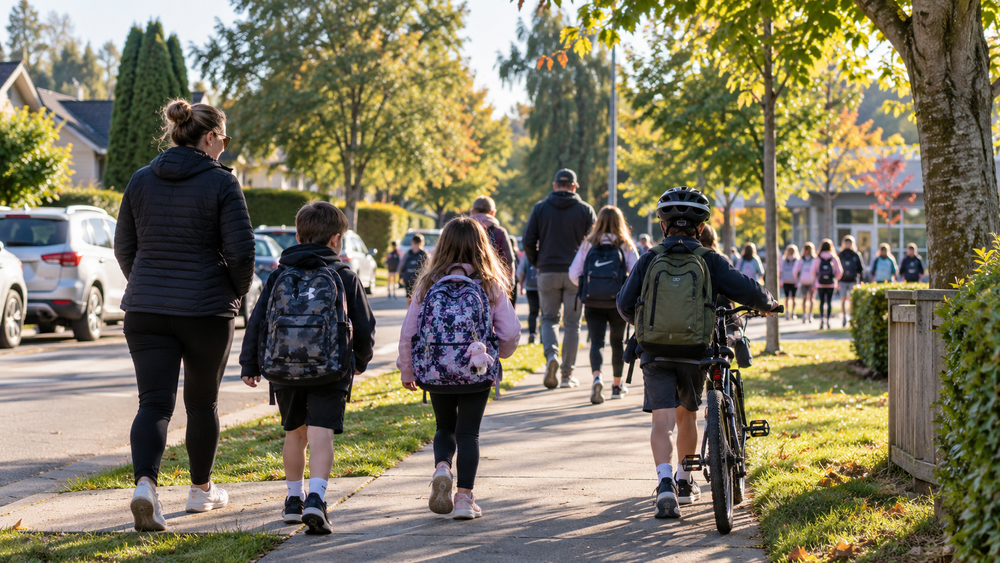
Growing Up in Delta today— Part 1
By Robert Skinner | Delta City News | September 07, 2026
You can Subscribe for Free To Delta City News: Click Here!
For generations, Delta has had many of the ingredients families look for when deciding where to put down roots.
Neighbourhood schools. Parks and playing fields. Recreation centres. Relatively safe streets. Beaches, farmland and nature close to home. And communities where it is still quite possible to run into someone you know at the grocery store.
But in 2026, there is another question worth asking:
Is Delta still a great place to raise a family — and will it remain one?
That question launches a new Delta City News series, Growing Up in Delta, examining what life here is really like for children, teenagers, parents and young families.
There Is Still a Lot Going for Delta
Start with safety.
Statistics Canada data released this summer put Delta's 2025 Crime Severity Index at 59.2, compared with 75.0 nationally and 92.4 across British Columbia. Delta Police describes the city as continuing to rank among Canada's safer communities.
That matters enormously to families.
So does recreation.
Delta residents aged 18 and under are eligible for the City's free YAK Pass, providing access to municipal recreation facilities and drop-in activities including swimming, skating and gymnasium programs.
The City is also undertaking a substantial recreation investment program. In June, Delta reported approximately $209 million in investments encompassing parks, sports facilities, playground improvements and projects including the Winskill Renewal.
There are after-school programs, arts and cultural activities, libraries, playing fields, pools, community centres, trails and a remarkable amount of natural space.
On paper, Delta has a strong hand.
But Raising a Family Is Changing
Talk to young parents, however, and another side of the story quickly emerges.
Housing is expensive. Childcare can be difficult to arrange. Organized activities add to household expenses and increasingly busy schedules. Traffic affects the school run. Many parents commute outside the community for work.
And the traditional idea of childhood itself has changed.
How many children still walk or cycle to school on their own?
How often do kids simply knock on a friend's door and disappear outside to play until dinner?
How much of childhood now takes place in scheduled programs — or behind a screen?
Those aren't problems unique to Delta. But they are part of what it means to raise children here today.
Then There Is an Interesting School Question
Delta is planning for additional housing and population growth, but the Delta School District entered the 2026/27 budget process forecasting something quite different in its classrooms.
The district estimated enrolment would decline by 245 students, from 16,140 in its 2025/26 amended budget to approximately 15,895 for 2026/27.
At the same time, the district projected an operating shortfall of approximately $1.98 million.
Those numbers are estimates and actual September enrolment will ultimately determine provincial funding. But they raise an intriguing question.
If Delta is expected to grow, where are the children?
Is Delta becoming increasingly difficult for younger families to afford?
Are household sizes changing?
Are families moving elsewhere?
Or will new housing eventually reverse the enrolment trend?
We will examine that question later in this series.
Three Communities — And Three Different Experiences
There is another danger in talking about "raising a family in Delta" as though everyone experiences the same Delta.
They don't.
A family in North Delta may have very different concerns and opportunities from one in Ladner.
A family in Tsawwassen may have another experience again.
Housing choices, transportation, schools, recreation, neighbourhood design and access to services vary considerably across the municipality.
That's why this series won't attempt to declare Delta either a wonderful or terrible place to raise children.
The more useful question is:
What's working, what's becoming more difficult, and what kind of community are we creating for the next generation?
Growing Up in Delta
Over the coming weeks, Delta City News will look at some of those questions.
We'll examine whether young families can still afford to establish themselves here.
We'll look at schools and future population growth.
We'll look at the daily school run and the streets surrounding our schools.
We'll explore what happened to the childhood freedom many previous generations took for granted.
And, importantly, we'll ask some Delta teenagers themselves what they think about growing up here — and whether they can imagine calling Delta home when they become adults.
Because perhaps the best measure of a community isn't simply whether people want to move there.
It's whether the children who grow up there will someday want to stay.
What do you think?
Is Delta still a great place to raise a family? What's the best part — and what's becoming more difficult?
Delta City News would like to hear from parents, grandparents, educators and young people across North Delta, Ladner and Tsawwassen.
Growing Up in Delta is a September 2026 special series from Delta City News.
Robert Skinner - Publisher
Delta City News — Licensed Partner of the WBN News Network
Robert is a Ladner-based business systems developer and Publisher of Delta City News. Connect with Robert on: https://www.linkedin.com/in/rlskinner/
You can Subscribe for Free To Delta City News: Click Here!
Also Please Note: We're Looking For Citizen Journalists
If you have a passion for your community in any category, food, sports, lifestyle and would like to help tell your Delta's stories, we'd love to hear from you. Part-time contributor opportunities are available, and ChatGPT-assisted journalism training is provided if desired for qualified applicants.
Apply To Be A News Contributor Here
#Growing Up in Delta #Families #Children #Education #Community#Delta School District #North Delta #Ladner #Tsawwassen