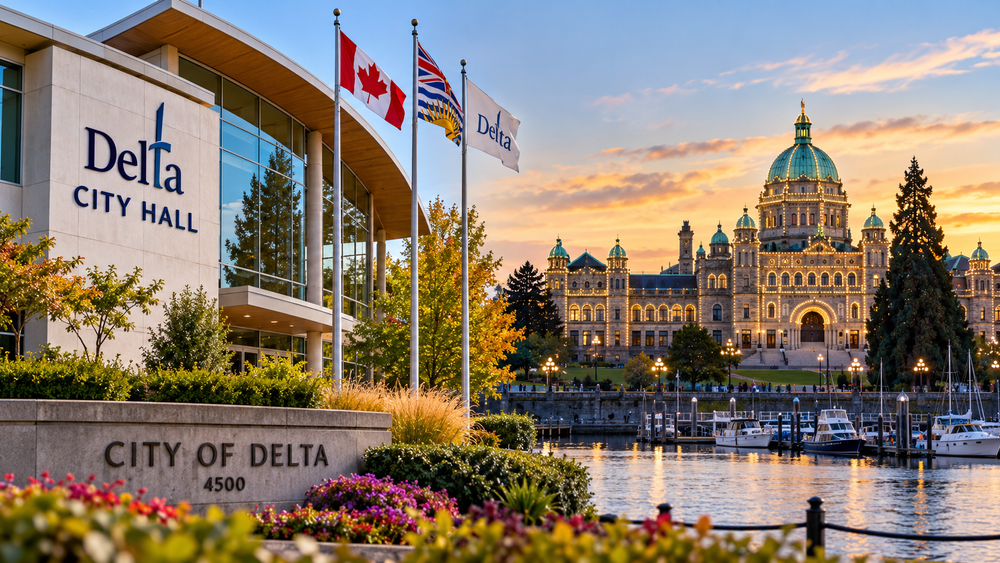
Conservatives capture both provincial ridings, a new mayor prepares to take office, and Delta faces a new political era at City Hall and in Victoria.

By Robert Skinner | Delta City News | Monday, October 26, 2026

Please Subscribe for Free To Delta City News: Click Here!


What a difference eight days can make.

Delta residents have barely had time to digest the results of their October 17 municipal election, which saw Mayor George Harvie defeated and Melissa Granum elected as his successor.

Now, following Saturday's provincial election, another major political shift has taken place.

For the first time in years, both Delta North and Delta South are represented by Conservatives, and British Columbia is preparing for a new Conservative majority government.

The results leave Delta with a new mayor, a substantially reshaped council, a new MLA in North Delta and a returning MLA in South Delta.

The election campaigns are over. The real work is about to begin.

A Conservative Sweep Across Delta

Saturday's provincial election delivered two decisive results locally.

In Delta North, Conservative Monica Mohan defeated BC NDP candidate Todd Schierling, winning 9,796 votes to Schierling's 7,425. Centre BC candidate Kuldeep Rangi received 1,062 votes.

Mohan captured approximately 53.6% of valid votes, ending the NDP's representation of the riding following Ravi Kahlon's decision not to seek re-election.

The result represents a substantial political change in North Delta, where the NDP had enjoyed considerable electoral strength.

In Delta South, incumbent Conservative Ian Paton secured another term with 14,473 votes, approximately 59.9% of valid ballots.

His principal challenger, NDP candidate Jason McCormick, received 6,918 votes. Green candidate Skadi Green finished with 1,988, followed by OneBC candidate Jim McMurtry with 799.

Paton's victory was convincing, reinforcing his position as South Delta's representative in Victoria.

The figures are preliminary and remain subject to Elections BC's final counting process.

British Columbia Changes Government

The provincial election delivered an even more dramatic result.

The Conservative Party, led by Lorne Doerkson, is projected to form a majority government, ending nine years of NDP government.

With almost all preliminary ballots reported, the Conservatives were leading or elected in 64 of British Columbia's 93 constituencies, compared with 27 for the NDP and two for the Green Party.

The results represent the first Conservative provincial election victory in British Columbia in nearly a century.

Outgoing Premier David Eby also announced his resignation as NDP leader on election night.

The incoming government has promised a different approach to economic development, resource projects, regulation and provincial finances.

For Delta, those promises could have significant implications.

And Just One Week Earlier, Delta Changed Its Own Government

The provincial election followed an equally consequential municipal contest.

On October 17, voters elected Melissa Granum as Delta's new mayor, defeating both Dylan Kruger and incumbent George Harvie.

Granum received 16,197 votes, compared with 9,460 for Kruger and 7,782 for Harvie.

The election ended Harvie's eight years as mayor and produced a council with a different political composition.

Delta First secured the mayor's office and three of the six council seats, giving the organization four of seven positions around the council table.

The new council consists of:

  • Alicia Guichon — Achieving for Delta
  • Tammy Hansen — Delta First
  • Alexander Fischer — Delta First
  • Sylvia Bishop — One Delta
  • Jat Puri — Delta First
  • Daniel Boisvert — One Delta

The results provide Granum with a potential working majority, although councillors remain responsible for making decisions on the merits of individual issues.

The new council is scheduled to begin its term in November.

What Happens to the George Massey Tunnel?

Perhaps no provincial infrastructure issue is more important to Delta than the replacement of the aging George Massey Tunnel.

During the provincial election campaign, the Conservatives proposed abandoning the current eight-lane immersed-tube tunnel replacement in favour of a 10-lane bridge.

That would represent another major change in direction for a project already affected by years of political decisions, redesigns, delays and rising costs.

With the Conservatives now preparing to govern, the bridge proposal moves from an election promise to a potential government policy.

But important questions remain.

What would a new bridge cost? Would existing environmental approvals need to be revisited? What happens to money already spent on the tunnel replacement? And how much longer would Delta commuters and commercial traffic have to wait?

For thousands of Delta residents who travel Highway 99 regularly, these are not abstract political questions.

They affect daily commuting, commercial transportation, local businesses and the movement of goods through one of Canada's busiest trade corridors.

Housing, Healthcare and Development Remain Front and Centre

The elections may be over, but the issues that dominated both campaigns remain.

Housing affordability continues to challenge younger families and first-time buyers.

The future of the Ladner waterfront, development pressures in Tsawwassen and North Delta, and neighbourhood concerns about density and infrastructure will confront the incoming municipal council.

Healthcare remains equally important.

Delta Hospital, long-term care capacity, access to family doctors and the proposed North Delta Urgent and Primary Care Centre all require attention from provincial decision-makers.

And for local businesses, rising operating costs, taxation, staffing challenges and transportation bottlenecks remain everyday realities.

Voters will now be watching to see whether the campaign commitments translate into practical improvements.

A New Opportunity for Delta?

One interesting consequence of the provincial election is that both Delta MLAs will belong to the party forming the next government.

That could provide opportunities for the community to advance infrastructure, healthcare and economic-development priorities directly with provincial decision-makers.

However, shared party affiliation does not automatically guarantee funding or project approvals.

The incoming mayor and council will need to establish productive working relationships with both MLAs and the new provincial cabinet.

The same applies to Delta's relationships with Tsawwassen First Nation, regional governments and federal representatives.

Effective cooperation across those jurisdictions will be essential to addressing major local issues.

One Number Worth Remembering: Voter Turnout

There is another important story within the election results.

Delta's municipal election attracted approximately 43.3% of registered voters.

Provincially, preliminary turnout was approximately 48%, pointing to historically low participation.

In both elections, more than half of eligible voters did not cast ballots.

That raises a question worth considering as Delta enters a new political chapter: How can elected representatives engage more residents in decisions affecting their communities?

Public consultation, accessible council meetings and clear communication will be important tests of the new municipal administration.

The Campaign Signs Will Come Down. The Expectations Won't.

In just eight days, Delta residents have helped elect a new municipal government and participated in a provincial election that changed the government in Victoria.

Some familiar political faces are departing. Others are returning. New leaders are preparing to take office.

But the community's priorities have not disappeared with the campaign signs.

Residents still want safe neighbourhoods, affordable housing, reliable healthcare, responsible development, strong local businesses and transportation infrastructure that works.

The challenge now belongs to those elected.

For Delta, the next chapter begins not with another election promise, but with the decisions made after the votes have been counted.

Delta City News will continue following the incoming municipal and provincial governments, examining their commitments and reporting on the decisions that affect residents and businesses across North Delta, Ladner and Tsawwassen.


Sources and election information

Editor's note: Provincial election results cited in this article are preliminary as of October 25, 2026. Final counting is scheduled for November.


Robert Skinner - Publisher

Delta City News — Licensed Partner of the WBN News Network

Robert is a Ladner-based business systems developer and Publisher of Delta City News. Connect with Robert on: https://www.linkedin.com/in/rlskinner/

You can Subscribe for Free To Delta City News: Click Here!

Also Please Note: We're Looking For Citizen Journalists

If you have a passion for your community in any category, food, sports, lifestyle and would like to help tell your Delta's stories, we'd love to hear from you. Part-time contributor opportunities are available, and ChatGPT-assisted journalism training is provided if desired for qualified applicants.

Apply To Be A News Contributor Here

Tags: Delta City News, Delta Politics, Municipal Election 2026, BC Election 2026, Melissa Granum, Monica Mohan, Ian Paton, Delta Community

Share this article
The link has been copied!