By Robert Skinner | Delta City News | November 6, 2026
Please Subscribe for Free To Delta City News: Click Here!
With a new provincial government, a newly elected Delta mayor and encouraging signals from Ottawa, the proposed 10-lane bridge may have something previous crossing plans lacked: an opportunity for coordinated political leadership.
A new chapter in a long-running transportation debate
For nearly a decade, the future of the George Massey crossing has been shaped by changing governments, competing engineering proposals and disagreements over how best to replace one of Metro Vancouver's most important transportation links.
Now, following British Columbia's October provincial election and Delta's municipal election, the political landscape has changed considerably.
The incoming BC Conservative government has committed to abandoning the eight-lane immersed-tube tunnel project in favour of a 10-lane bridge.
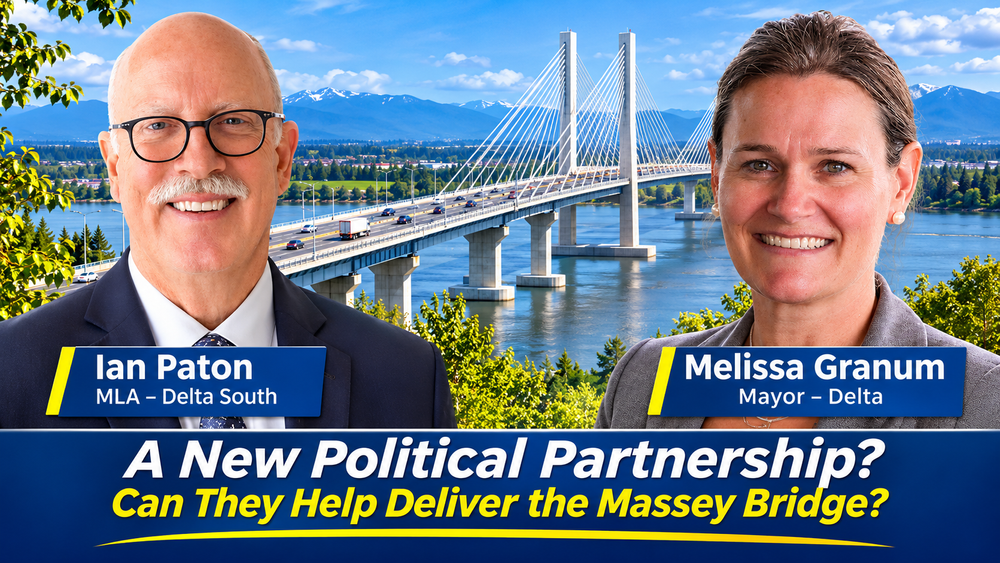
Delta South MLA Ian Paton has emerged as one of the strongest advocates for that change.
And Delta's newly elected mayor, Melissa Granum, has publicly indicated that she supports the bridge option, provided the province can demonstrate the promised advantages.
Perhaps most significantly, the federal government has signaled that it is willing to support the province's preferred crossing, whether bridge or tunnel.
For Delta residents, the question is no longer simply whether a bridge is preferable to a tunnel.
It is whether this new combination of provincial, municipal and federal leadership can finally deliver a replacement crossing without another prolonged cycle of planning, political disagreement and escalating costs.
Ian Paton: A longtime advocate for the bridge
Ian Paton has consistently advocated replacing the existing George Massey Tunnel with a new bridge.
During the October provincial election campaign, Paton argued that the bridge could be completed more quickly and at substantially lower cost than the NDP government's $8.5-billion tunnel proposal.
In an October 30 interview with CityNews, Paton estimated that a bridge could save approximately $5 billion and suggested motorists could be using the new crossing within five years.
He also pointed to the environmental assessment completed for the earlier bridge proposal as a potential advantage in accelerating the project.
Those are substantial claims, and they have generated understandable public interest.
But they remain projections rather than independently verified results of a newly approved bridge business case.
A previous environmental assessment may provide a useful starting point. It does not necessarily eliminate the need for updated engineering, environmental review, consultation or regulatory approvals.
Likewise, a five-year completion target must eventually be supported by a detailed construction schedule and procurement strategy.
Paton's role will therefore be more demanding than simply advocating for the bridge.
As Delta South's provincial representative, he will be expected to help turn the government's commitment into a deliverable infrastructure project.
That means maintaining attention on cost, construction timing, highway connections, environmental impacts and the concerns of residents and businesses on both sides of the river.
Melissa Granum: A new municipal voice
Delta's mayor-elect brings a fresh opportunity for municipal involvement.
Melissa Granum won Delta's October 17 municipal election, defeating incumbent mayor George Harvie and councillor Dylan Kruger.
Official election results show Granum receiving 16,197 votes, representing approximately 47.8 per cent of ballots cast in the mayoral race.
Her position on the Massey crossing is particularly important.
In the October 30 CityNews report, Granum expressed a preference for a bridge, conditional on the province demonstrating its proposed advantages.
That distinction matters.
Municipal support should not mean accepting provincial claims without examination.
Delta's mayor and council have a responsibility to consider the project's implications for local transportation, businesses, agricultural lands, the environment and neighbourhoods.
A bridge may be a provincial infrastructure project, but its consequences will be felt directly in Delta for generations.
Granum's opportunity is to establish a constructive working relationship with the provincial government while ensuring Delta's interests remain central to project planning.
That includes asking difficult questions when necessary.
Can North and South Delta speak with one voice?
For many years, Delta has experienced the practical challenges of being one municipality with two distinct geographic and economic areas.
North Delta's daily transportation connections are strongly oriented toward Surrey and the wider Metro Vancouver region.
South Delta depends heavily on Highway 99 and the George Massey crossing for access to Richmond, Vancouver and regional employment centres.
Meanwhile, the industrial and commercial activities of Tilbury, Annacis Island and the Roberts Bank port corridor depend on efficient goods movement throughout the region.
A successful replacement crossing would benefit far more than the motorists travelling through the existing tunnel.
It would influence commercial transportation, transit, emergency access, business investment and regional economic development.
This creates an opportunity for Delta's provincial representatives, including North Delta MLA Monica Mohan, to work together with the mayor and council on a shared set of priorities.
The goal should not be to erase the different needs of North and South Delta.
It should be to recognize that reliable regional transportation benefits the entire municipality.
An effective approach would bring both provincial constituencies and Delta City Hall into regular discussions with the Ministry of Transportation and Transit.
That would help ensure that local concerns are addressed before major decisions become difficult or expensive to change.
Ottawa offers an encouraging signal
One of the most significant developments occurred on October 30 during a federal announcement concerning the Roberts Bank Terminal 2 project.
Federal Transport Minister Steven MacKinnon indicated that Ottawa would support British Columbia's preferred approach to replacing the Massey crossing.
His comments were particularly important because the previous provincial government had emphasized the risk of losing federal support if the tunnel project were abandoned.
MacKinnon's statement suggests that federal participation is not necessarily dependent on proceeding with the tunnel design.
That is encouraging news for the incoming provincial government.
However, political support in principle is not the same as a finalized funding agreement.
The province and Ottawa will still need to establish the financial arrangements, project scope and conditions associated with any federal contribution to a bridge.
Those details will be essential to understanding the actual cost to British Columbia taxpayers.
The encouraging development is that the two senior levels of government appear willing to discuss the same project rather than defend competing designs.
For a crossing that serves regional, provincial and national transportation needs, that cooperation is particularly important.
Richmond must also be part of the discussion
There is another political relationship that cannot be overlooked.
The new crossing will connect Delta and Richmond.
While Delta has often expressed strong support for a bridge, Richmond's municipal government opposed the earlier bridge proposal, including concerns about agricultural land and green space.
Those concerns cannot simply be dismissed because the provincial government has changed.
A successful bridge project will require serious consultation with Richmond, Indigenous governments, affected landowners, environmental organizations and regional transportation agencies.
The location of bridge approaches, highway interchanges and supporting infrastructure will be important.
So will the potential effects on the Fraser River and surrounding communities.
Political cooperation should not mean avoiding disagreement.
It should mean addressing legitimate concerns early enough to prevent another lengthy and expensive delay.
What about the workers and construction already underway?
As examined in Part 2 of this series, the proposed change comes after substantial expenditures and preparatory construction on the tunnel project.
The BC Building Trades organization has warned that approximately 200 tradespeople currently working on the project could lose their jobs if construction is cancelled, with additional future employment also at risk.
This presents an immediate challenge for the incoming government.
If a bridge is the preferred solution, how quickly can construction activity transition to the new project?
Can existing contractors, workers and equipment be retained?
Which completed site preparations and engineering studies can be incorporated into bridge construction?
A responsible transition plan should address these questions alongside the new bridge budget.
The objective should be to avoid turning a change in project direction into another prolonged period of inactivity.
Political agreement is not the same as project delivery
The history of the Massey crossing demonstrates that political announcements are only the beginning.
The original 10-lane bridge was cancelled after the NDP formed government in 2017.
The replacement tunnel subsequently underwent years of planning, procurement changes and substantial cost increases.
Now the province is preparing to change direction again.
There are reasons to believe a bridge may offer advantages, but those advantages must be demonstrated through updated engineering and financial analysis.
The incoming government needs to establish a credible plan that can withstand scrutiny and, ideally, survive future changes in political leadership.
For Delta's representatives, this means moving beyond expressions of support.
It means helping secure transparent milestones, clear responsibilities and regular public reporting.
Five priorities for Delta's new political leadership
The emerging partnership between provincial and municipal representatives should focus on five practical objectives.
First, establish a verified bridge budget. The public needs a current cost estimate that includes design, construction, highway connections, transition expenses and potential contract termination costs.
Second, publish a realistic completion schedule. Ian Paton's proposed five-year target should be tested against the time required for approvals, procurement and construction.
Third, protect Delta's transportation interests. Local highway access, transit improvements, goods movement and emergency response must remain part of the project.
Fourth, secure formal federal participation. Ottawa's encouraging statements should be followed by a clear financial commitment and agreed project responsibilities.
Fifth, maintain public accountability. Residents should receive regular progress reports showing expenditures, construction milestones and any changes to the project schedule.
These are practical measures that could help prevent the crossing from becoming another casualty of political change.
The opportunity ahead
The proposed return to a 10-lane bridge has created renewed expectations among Delta residents and businesses.
Ian Paton believes a bridge can be built faster and at substantially lower cost.
Melissa Granum has indicated support for the bridge if those advantages can be demonstrated.
Ottawa has signaled a willingness to participate.
Together, these developments represent a potentially important opportunity.
But there is a considerable difference between political alignment and successful infrastructure delivery.
The challenge now is to transform promises into a financially credible, technically sound and publicly accountable construction program.
For Delta, the objective should remain straightforward.
Build the crossing that offers the best combination of cost, completion time and long-term reliability — and get it built.
After years of uncertainty, that is the outcome residents, businesses and commuters deserve.
Robert Skinner — Publisher, Delta City News
Delta City News provides independent community and business reporting on the people, infrastructure and decisions shaping Delta.
Coming Next — Part 4
Bridge Versus Tunnel: Which Crossing Really Offers Delta the Better Future?
A closer examination of construction costs, engineering challenges, environmental considerations, safety, maintenance and long-term reliability.
Robert Skinner - Publisher
Delta City News — Licensed Partner of the WBN News Network providing independent community and business reporting covering the people, infrastructure and issues shaping Delta.
Robert is a Ladner-based business systems developer and Publisher of Delta City News. Connect with Robert on: https://www.linkedin.com/in/rlskinner/
You can Subscribe for Free To Delta City News: Click Here!
Also Please Note: We're Looking For Citizen Journalists
If you have a passion for your community in any category, food, sports, lifestyle and would like to help tell your Delta's stories, we'd love to hear from you. Part-time contributor opportunities are available, and ChatGPT-assisted journalism training is provided if desired for qualified applicants.
Apply To Be A News Contributor Here
Delta Infrastructure, George Massey Bridge, George Massey Tunnel, Ian Paton, Melissa Granum, Provincial Government, Delta City Council, Transportation, Special Report