By Robert Skinner | Delta City News | March 06, 2026
Subscribe Free To Delta City News: Click Here
Tilbury Industrial Park is not a shipping port.
It does not have container cranes or ocean terminals. What it does have is something equally important: position.
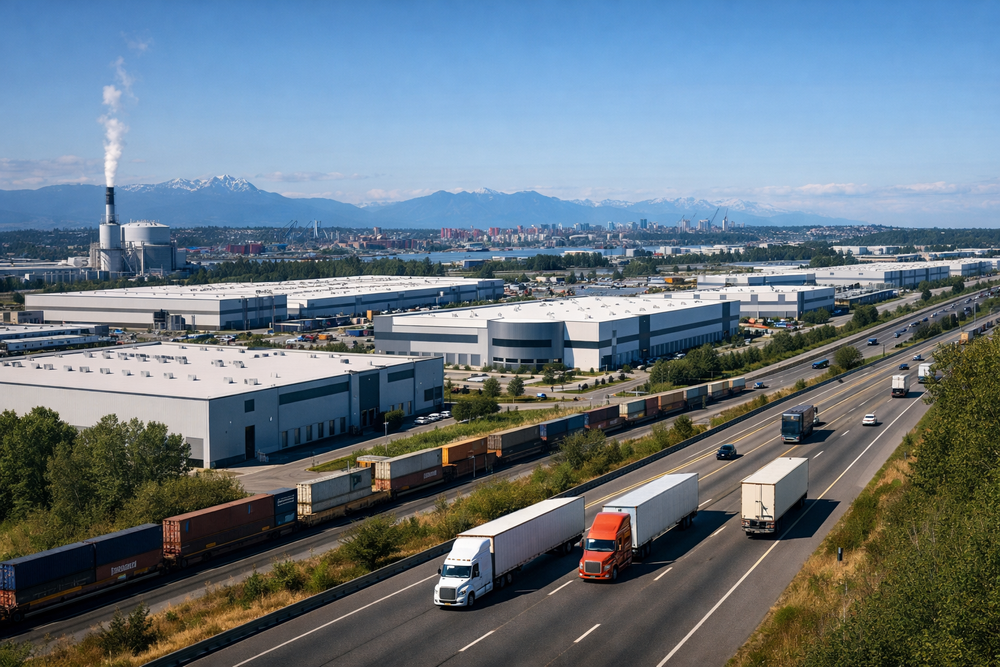
Located approximately 15 kilometers inland from major marine terminals operated by the Port of Vancouver and a similar distance from the Canada–U.S. border, Tilbury functions as a strategic inland distribution corridor linking port activity, highway freight, and cross-border trade.
That distinction matters.
Ports handle cargo transfer between ships and land.
Industrial corridors like Tilbury handle storage, processing, redistribution, and onward transportation.
In many ways, that makes Tilbury the engine room behind the headlines.
With direct access to Highway 17 and Highway 99, the corridor connects westward to marine terminals, southward to Washington State and all of the USA, and eastward into the broader Canadian market. Rail infrastructure further supports bulk and containerized freight movement.
Industrial vacancy rates across Metro Vancouver remain tight, and Tilbury has seen sustained investment in modern warehouse construction facilities built taller, with expanded loading capacity, and increasingly integrated with warehouse management technology.
This growth is not speculative. It is driven by supply chain geography.
Goods arriving at marine terminals need inland staging space.
Products crossing the U.S. border require distribution capacity.
E-commerce and regional retailers depend on strategically located warehousing within driving distance of population centres.
Tilbury sits at the intersection of those needs. For Delta, the implications are practical.
Ad: Learn About Being A Writer For Free & The Benefits Click Here
Industrial expansion supports employment in logistics, fleet operations, equipment servicing, compliance management, and skilled trades. It also increases demand for professional services, accounting, IT systems, safety training, and workforce recruitment.
At the same time, growth brings infrastructure pressure. Truck traffic along Highway 17 remains a visible reminder that industrial success must be supported by road planning and traffic management. Labour availability, particularly in skilled logistics and supervisory roles, continues to influence operational efficiency.
The opportunity lies not only with large distribution operators but with the service ecosystem that surrounds them.
Small and mid-sized businesses positioned to support warehousing, fleet maintenance, food services for shift workers, and industrial technology solutions are tied directly to the corridor’s health.
Tilbury does not compete with ports. It complements them.
It does not compete with border crossings. It feeds into them.
That is why its growth story is important.
Delta’s inland industrial capacity is a stabilizing economic force less visible than cranes on the waterfront, but just as essential to the flow of goods across Western Canada and into the United States.
Understanding that distinction is key to understanding where Delta’s long-term economic strength truly sits.
Robert Skinner- Robert is a Ladner based business systems developer and the Publisher of Delta City News. Give him a call at +1 604-220-4750 or connect on LinkedIn: https://www.linkedin.com/in/rlskinner/
Note: We are looking for Citizen Journalist to write for this News Platform on a P/T Basis. Chat GPT training is available.
Give Robert a call. Let’s connect and message him on LinkedIn if you are interested to learn more
Tags: #Delta City News #Delta BC #Tilbury Industrial #Inland Logistics #Cross Border Trade #Highway 17 #Local Business News